Should You Automate SEO Content? ROI Analysis and Decision Framework
Weigh the true costs, time savings, and quality trade-offs of SEO content automation. Data-driven framework to decide if automation fits your growth stage.

SEO content automation promises dramatic time savings and cost reductions, yet many businesses hesitate, uncertain whether the technology delivers genuine ROI or merely trades quality for speed. The decision hinges on precise calculations across three dimensions: hard costs, opportunity costs, and the revenue impact of ranking velocity versus content quality, each weighted differently depending on your current growth stage and competitive position.
This framework breaks down the actual financial trade-offs, time-to-revenue comparisons, and quality thresholds that separate profitable automation from expensive mistakes, giving you a structured method to evaluate whether seo content automation fits your specific situation right now.
What Does SEO Content Automation Actually Cost?
The all-in cost of seo content automation typically ranges from $200 to $2,000 per month depending on output volume, platform subscription tier, editorial oversight hours, and the human review layer you maintain. A realistic monthly budget for a business producing 20-40 automated articles includes the automation platform fee, fact-checking time, light editing, and the internal coordination to brief the system and review outputs before publishing.
Most platforms charge between $99 and $500 monthly for core automation features, with higher tiers unlocking bulk publishing, advanced keyword research integration, and automated internal linking. On top of the subscription, you need 10-15 hours of human time per month for oversight: briefing keyword targets, spot-checking factual accuracy, adjusting tone where the AI drifts generic, and final approval before publish.
| Cost Component | Monthly Range | Notes |
|---|---|---|
| Automation platform subscription | $99 - $500 | Scales with output volume and feature depth |
| Editorial oversight (10-15 hrs) | $300 - $1,125 | Internal or freelance editor at $30-75/hr |
| Keyword research tools | $0 - $200 | Often bundled; standalone if needed |
| Hosting and CMS plugins | $20 - $100 | API integrations, staging environments |
| Total monthly cost | $419 - $1,925 | For 20-40 articles/month with light review |
Compare this to hiring freelance writers at $150-300 per article: producing 30 articles monthly costs $4,500-9,000 in writing fees alone, before editing, project management, or keyword research time. Automation cuts the direct writing cost by 70-90%, but only if the output quality still drives traffic and conversions at a comparable rate.
How Much Time Does Automation Actually Save?
A fully manual content workflow, from keyword research through final publish, typically consumes 6-10 hours per article when you include outlining, drafting, editing, image sourcing, internal linking, metadata writing, and CMS formatting. Automation collapses that timeline to 15-30 minutes of human time per piece: briefing the system with target keywords, reviewing the output for factual accuracy and tone consistency, and approving the publish.
For a business targeting 30 articles per month, the manual path demands 180-300 hours of labor, nearly two full-time employees dedicated solely to content production. The automated path requires 7.5-15 hours of oversight, freeing up 165-285 hours monthly that can shift to distribution, link building, conversion optimization, or expanding into additional content channels.
What tasks remain manual even with automation?
Even the most advanced ai seo automation platforms cannot autonomously handle strategic keyword prioritization, brand voice calibration, fact-checking claims against proprietary data, or adjusting content angle to match shifting search intent. You still need human judgment to choose which keywords to target this month, verify that automated outputs do not contradict your product documentation, and spot-check that the tone matches your brand guidelines rather than drifting into generic SEO-speak.
Expect to spend 5-10 minutes per article on pre-publish review, another 10-15 minutes monthly on batch keyword selection and priority ranking, and occasional deeper intervention when a piece misses the mark on angle or specificity. The time savings are real, but they assume you maintain that oversight layer rather than publishing blindly.
Does Automated Content Rank as Well as Human-Written Articles?
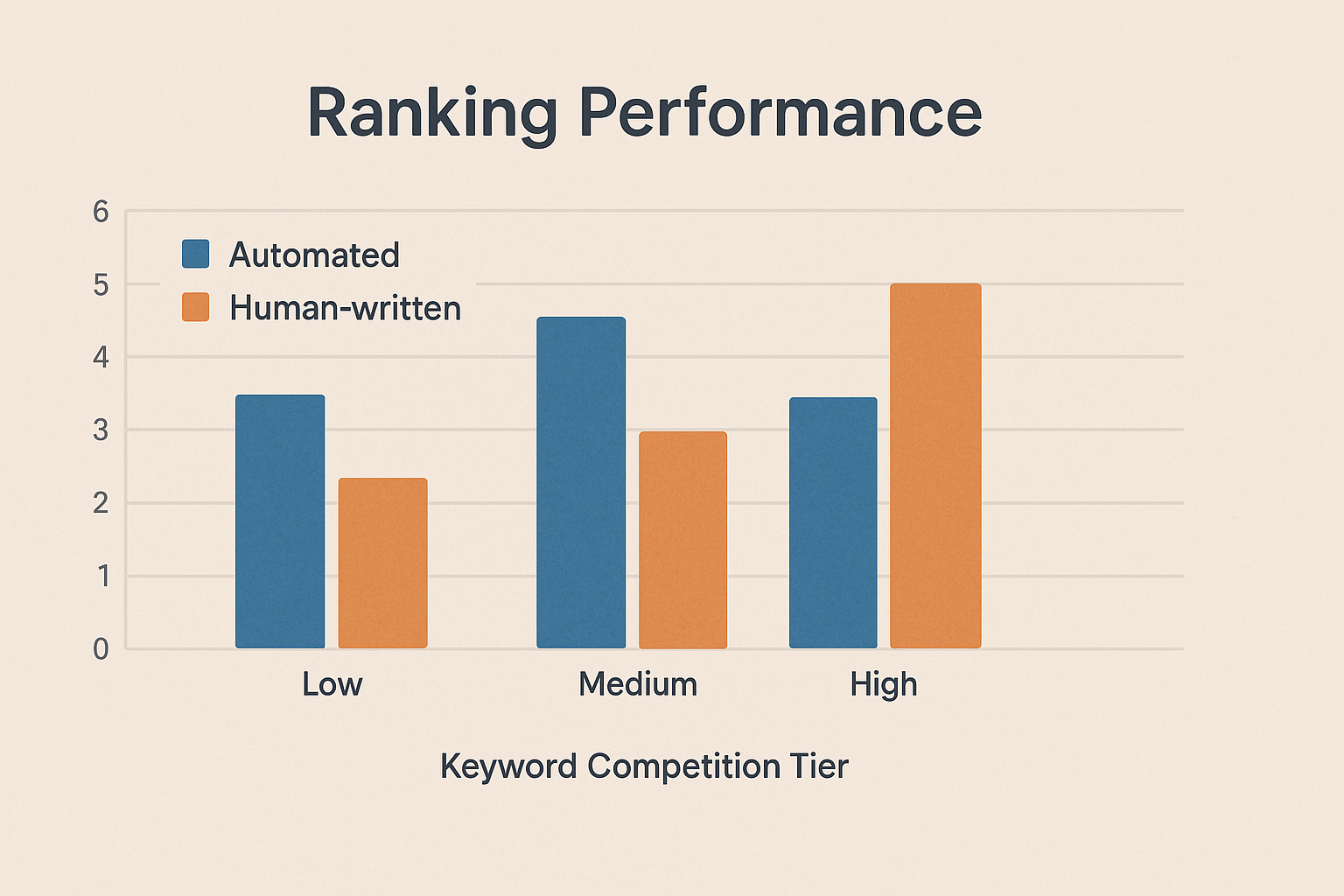
Automated content ranks comparably to human-written articles when the automation is paired with editorial review, proper keyword targeting, and a site that already demonstrates topical authority, but it underperforms on competitive head terms where depth, original research, and narrative cohesion separate top results from the rest. The quality threshold has risen sharply: Google and AI answer engines now reward specificity, named examples, and mechanistic explanations over surface-level keyword coverage, traits that automation handles inconsistently without human refinement.
In low-competition longtail queries, where the bar is basic accuracy and keyword presence, automation often matches or exceeds manual content by sheer volume and speed, allowing you to claim dozens of positions before competitors even identify the keywords. For higher-competition terms, automated drafts serve best as first-pass outlines that a human editor then enriches with case studies, data interpretation, and brand-specific examples.
How do AI answer engines evaluate automated content?
ChatGPT, Perplexity, and other AI answer engines prioritize content that opens each section with a direct, self-contained answer followed by supporting detail, a structure that aligns naturally with how modern seo content automation platforms generate articles. When automation produces clear question-and-answer pairs, consistent heading hierarchy, and citation-friendly formatting, AI engines cite it freely, sometimes preferring the concise, structured style of automated content over verbose human prose.
The risk lies in generic phrasing: if every automated article across the web uses identical transition phrases and the same vague examples, AI engines begin to discount the source as low-signal. Maintaining citation velocity requires injecting brand-specific terminology, real use cases, and concrete figures into automated drafts during the review pass.
When Does Automation Deliver Positive ROI?
Automation delivers positive ROI when your revenue per incremental organic visitor exceeds the all-in cost per article divided by the average monthly traffic that article generates, and when the speed advantage lets you capture keywords before competitors or scale content fast enough to match a paid acquisition channel's volume. For businesses with strong conversion infrastructure and high customer lifetime value, even a modest traffic gain per article justifies automation, because each visitor carries significant expected revenue.
Calculate your break-even threshold: if automation costs $1,000 monthly for 30 articles, you need each article to drive 34+ visits per month at a $1 visitor value to break even, or just 10 visits per month if your visitor value is $3. Early-stage companies with unproven conversion rates face higher risk, since traffic alone does not pay the bills, while growth-stage businesses with known unit economics can model ROI precisely.
What revenue milestones indicate readiness for automation?
Businesses generating at least $10,000 in monthly recurring revenue with proven organic conversion rates above 2% are typically ready to scale content through automation, because they have enough budget to sustain the subscription and oversight costs while the content accumulates traffic, and they have enough conversion data to forecast revenue impact confidently. Below that threshold, manual content or a hybrid approach often yields better ROI, since you lack the volume to amortize platform costs and the conversion certainty to justify speculative publishing.
If your current organic traffic already converts profitably, automation accelerates growth by expanding keyword coverage faster than manual workflows allow. If you are still testing messaging and offers, invest human writing time in fewer, higher-quality pieces that double as conversion experiments rather than automating at scale prematurely.
How Do You Calculate Cost Per Ranking Keyword?
Cost per ranking keyword equals your total monthly content spend divided by the number of keywords ranking in the top 20 positions at the end of that month, a metric that reveals whether automation or manual writing delivers more efficient visibility gains. Track this monthly: if automation costs $1,200 and nets you 80 new top-20 rankings, your cost per keyword is $15, compared to manual content at $6,000 for 60 rankings and a $100 cost per keyword.
This metric favors automation in volume-driven strategies targeting longtail keywords, where each article can rank for multiple related queries, but it can mislead if the rankings carry little traffic or commercial intent. Pair it with cost per 100 incremental organic visits to ensure you are optimizing for traffic that matters, not just ranking counts.
Should you measure time-to-rank differently for automated content?
Automated content often ranks faster than manual content because you can publish in higher volume, saturating a topic cluster within weeks rather than months, which signals topical authority to search engines more quickly. Measure time-to-first-page separately for automated versus manual articles: if automation averages 45 days to page one and manual averages 60 days, the speed advantage compounds when you are racing competitors for emerging keywords or seasonal topics.
However, faster initial ranking does not always mean sustained ranking. Monitor 90-day and 180-day position retention: if automated articles drop from page one after the initial honeymoon period, your quality threshold is too low, and you need to invest more editorial time per piece or reduce output volume to maintain standards.
What Quality Trade-Offs Should You Expect?
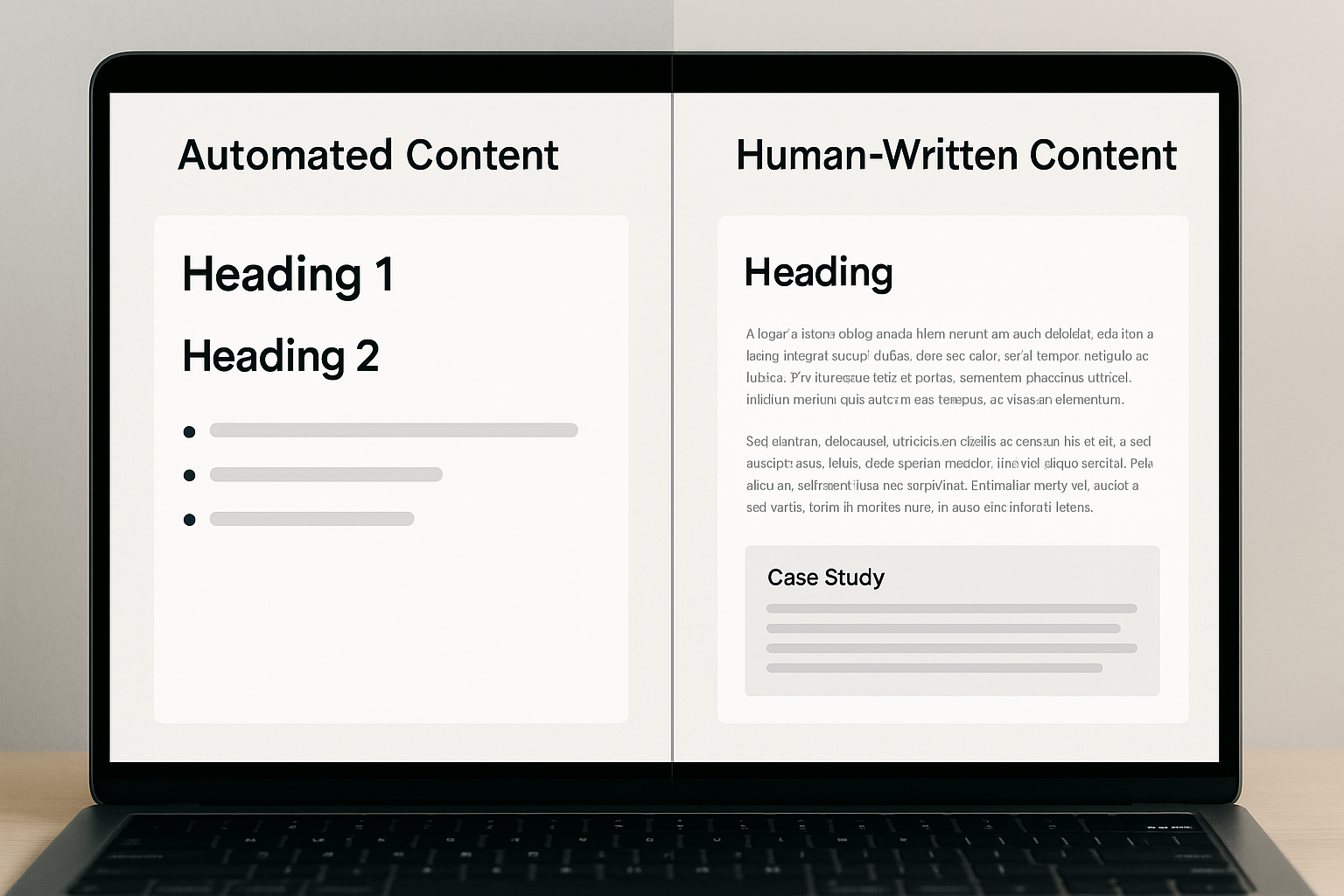
The primary quality trade-off in seo content automation is depth and originality: automated drafts excel at structured, informational content covering well-documented topics but struggle with nuanced argumentation, original data interpretation, and brand storytelling that requires deep product knowledge or industry experience. Expect automated content to perform well on how-to guides, comparison posts, and definitional articles, but to fall short on thought leadership, case studies, and content that differentiates your brand voice.
A hybrid strategy addresses this: automate the bulk of your informational content to capture longtail traffic and build topical coverage, then allocate manual writing time to pillar posts, product-led content, and high-competition keywords where quality directly impacts conversion rates. This lets you maintain brand integrity on high-visibility pages while scaling reach through automation.
Can automation handle technical or niche topics accurately?
Automation handles technical or niche topics accurately when the training data includes sufficient domain-specific content and when you provide detailed keyword briefs with context, but it fails when the topic requires synthesizing proprietary data, interpreting recent research, or applying industry-specific judgment that is not widely documented online. For SaaS products, API documentation, or emerging technology categories, plan to fact-check every technical claim and supplement automated drafts with internal subject-matter expert review before publishing.
If more than 30% of your automated drafts require substantial rewriting to correct technical errors, the topic is too specialized for current automation, and you are better served by manual content or by training a custom model on your proprietary documentation.
How Does Growth Stage Affect the Automation Decision?
Early-stage companies with fewer than 1,000 monthly organic visits should prioritize manual content that builds brand voice, tests messaging, and targets high-intent keywords where conversion matters more than volume, since automation's efficiency gains are wasted when you lack the traffic and conversion infrastructure to monetize the reach. Growth-stage companies scaling from 1,000 to 10,000 visits benefit most from a hybrid model, using automation to expand longtail coverage while manually crafting conversion-focused pillar content.
At scale, beyond 10,000 monthly visits, full automation with editorial oversight becomes viable because you have enough baseline traffic to measure incremental impact accurately, proven conversion funnels that monetize new visitors predictably, and the budget to sustain both platform costs and a dedicated content operations role. Your growth stage directly determines how much risk you can tolerate in the quality-versus-volume trade-off.
What signals indicate you have outgrown manual content?
You have outgrown manual content when your keyword opportunity backlog exceeds 200 targets, your internal team cannot produce more than 10-15 articles per month, and competitors are capturing longtail traffic faster than you can respond, creating a compounding visibility gap. At that point, continuing to rely solely on manual writing means surrendering market share to faster competitors, and the ROI calculation shifts decisively toward automation.
Another signal: when your cost per acquisition via paid channels exceeds $100 but your organic content historically converts at similar rates, the marginal cost of automated content becomes trivial compared to paid alternatives, justifying aggressive scaling through ai seo automation even if quality dips slightly.
Should You Automate All Content or Just Specific Types?
Automate informational and educational content targeting longtail keywords, product comparison posts, FAQ pages, and glossary entries, while keeping manual control over homepage copy, product pages, case studies, founder-led thought pieces, and any content directly tied to conversion or brand positioning. This selective approach lets you capture the volume benefits of automation without risking your brand voice on high-stakes pages that prospects evaluate closely when deciding to convert.
A practical ratio: aim for 70-80% of your monthly output to come from automation, with the remaining 20-30% manual or heavily edited, focusing human time where it delivers the highest marginal return. This balance maintains content velocity while preserving quality on the pages that matter most for revenue.
Which content formats are least suitable for automation?
Customer stories, original research reports, product launch announcements, and content requiring proprietary data or insider perspective are least suitable for automation because they depend on information the AI cannot access and on narrative coherence that automated systems struggle to maintain across longer, multi-threaded arguments. Keep these formats manual or use automation only to generate a rough structure that a human writer then completely rewrites.
Similarly, content designed to earn backlinks or social shares typically needs the creative angle, surprising insight, or emotional resonance that manual writing provides, since generic automated content rarely achieves the differentiation required to attract external attention.
How Do You Maintain Brand Voice With Automation?
Maintain brand voice with automation by providing detailed tone guidelines in your platform briefs, creating a style document with example sentences and forbidden phrases, and running every output through a quick editorial pass that adjusts phrasing, tightens transitions, and injects brand-specific terminology before publish. Most seo content automation platforms let you set tone parameters and reference documents, but AI interpretation of subjective style remains imperfect, so human review is essential.
Build a simple two-question editorial checklist: Does this sound like something our brand would say? Does this include at least one specific example or insight unique to our product or audience? If either answer is no, revise the section before publishing. This light touch preserves velocity while preventing the flat, interchangeable tone that marks low-quality automation.

Can you train automation to match your existing content?
Some advanced ai seo automation platforms offer fine-tuning or style-learning features where you upload 10-20 of your best existing articles and the system attempts to mimic your tone, sentence structure, and vocabulary patterns. Results vary widely: this works reasonably well for objective style attributes like sentence length and formality level, but it struggles with subtler elements like humor, cultural references, and the specific jargon your audience expects.
Even with training, plan to maintain editorial review. The training reduces the extent of revision needed per article, but it rarely eliminates the need entirely. Evaluate whether the improvement justifies the setup time by running a pilot: generate five articles with default settings, then five more after training, and measure the revision time required for each batch.
What Metrics Should You Track to Evaluate Automation Performance?
Track six core metrics to evaluate automation performance: cost per article published, human hours per article, new keywords ranking in top 20, incremental organic traffic attributable to automated content, conversion rate of automated content versus manual content, and citation rate in AI answer engines. These six numbers together reveal whether automation is delivering net positive ROI or merely inflating vanity metrics like publish volume without corresponding revenue impact.
Set a monthly review cadence: compare the current month's automated content performance against the prior month and against a control set of manual articles published in the same period. If automated content consistently underperforms on conversion rate by more than 20%, the quality bar is too low, and you need to either increase editorial oversight or reduce automation scope to higher-performing content types.
| Metric | Target Range | What It Reveals |
|---|---|---|
| Cost per article (all-in) | $15 - $65 | Automation efficiency versus manual cost baseline |
| Human hours per article | 0.25 - 0.5 hrs | Oversight burden; higher means more fixes needed |
| New top-20 keywords per article | 2 - 5 | Ranking effectiveness and keyword research quality |
| Incremental monthly traffic per article | 20 - 100 visits | Actual traffic value, adjusts for ranking quality |
| Conversion rate (automated vs manual) | 80-100% parity | Revenue impact; major gap signals quality issue |
| AI citation rate | 10-20% of articles | ChatGPT and answer engine visibility |
How long should you wait before judging automation success?
Wait at least 90 days before making a definitive judgment on automation success, since new content typically takes 30-60 days to reach stable rankings and another 30 days to accumulate enough traffic for statistically meaningful conversion data. Run a structured three-month pilot: automate 30-50 articles, maintain your usual editorial standards, track the six core metrics monthly, and compare final results against your manual content baseline and your ROI threshold.
If the pilot shows positive ROI and acceptable quality, scale up gradually, doubling output each quarter while monitoring whether quality holds as volume increases. If the pilot falls short, diagnose whether the issue is platform capability, editorial process, keyword selection, or simply a mismatch between your content needs and what automation handles well.
Decision Framework: Should You Automate Now?
Use this three-part decision framework to determine if now is the right time to adopt seo content automation: first, verify that you have proven organic conversion rates above 1.5%, existing content that already ranks and converts, and at least $1,000 monthly budget for content after all other growth expenses are covered. Second, confirm that your keyword opportunity backlog exceeds your current manual publishing capacity by at least 3:1, meaning competitors are capturing traffic you cannot reach at your current pace. Third, ensure you have at least 5-10 hours per month available for editorial oversight, since automation without review produces more risk than reward.
If all three conditions are met, start with a constrained pilot: 20-30 articles over three months, all in a single content category where quality thresholds are well-defined and easy to measure. If any condition is missing, delay automation and focus instead on manual content that builds conversion infrastructure, proves your organic channel, or develops the editorial processes you will need to oversee automation later.
What are the warning signs that automation is not working?
Warning signs that automation is not working include declining average position for automated articles after 90 days, conversion rates on automated content below 60% of manual content benchmarks, rising editorial revision time approaching manual writing time, frequent factual errors requiring correction post-publish, and flat or declining AI citation rates despite increasing output volume. Any single signal warrants investigation; two or more together indicate a fundamental mismatch requiring either platform change, process overhaul, or a return to manual content.
Also watch for increasing sameness across your content: if every article follows an identical structure with interchangeable examples, your automation is producing filler rather than genuinely useful content, and search engines will eventually discount your site accordingly. Diversity in structure, angle, and depth is a leading indicator of sustainable automation quality.
Frequently Asked Questions About SEO Content Automation ROI
How much does SEO content automation typically cost per month?
SEO content automation typically costs between $400 and $2,000 per month when you include platform subscription fees, editorial oversight hours, and supporting tools like keyword research and CMS integrations. Most businesses producing 20-40 automated articles monthly land in the $800-1,200 range, which is 70-90% cheaper than hiring freelance writers at typical per-article rates.
Does automated content rank as well as human-written articles in Google?
Automated content ranks comparably to human-written articles for low-competition longtail keywords when paired with editorial review and proper keyword targeting, but it underperforms on competitive head terms where depth, originality, and brand differentiation matter most. The quality gap has narrowed significantly, especially for informational content following clear structure and question-answer formats that both Google and AI answer engines reward.
What is the break-even point for content automation ROI?
The break-even point for content automation ROI occurs when the revenue from incremental organic traffic generated by automated articles exceeds the all-in monthly cost of the platform, oversight, and supporting tools. For most businesses, this requires each automated article to drive 10-50 visits per month depending on your visitor-to-revenue conversion rate, typically achieved within 60-90 days of publication for longtail keywords.
Can you maintain brand voice with automated content?
You can maintain brand voice with automated content by providing detailed tone guidelines, running every output through a quick editorial review to adjust phrasing and inject brand-specific examples, and using style reference documents that the platform can learn from. However, this requires consistent human oversight; publishing automated content without review almost always results in generic, interchangeable tone that weakens brand identity.
Should early-stage startups use content automation?
Early-stage startups with fewer than 1,000 monthly organic visits should generally avoid full automation and focus instead on manual content that builds brand voice, tests messaging, and targets high-intent keywords where conversion matters more than volume. Automation delivers the greatest ROI when you already have proven conversion rates, sufficient budget to sustain the investment during the ranking lag period, and a large enough keyword backlog that manual publishing cannot keep pace with opportunity.

RankHit
RankHit official
RankHit researches keywords, writes SEO articles, and publishes them on autopilot so brands can rank on Google and get cited by ChatGPT.