AI Content Generator for SEO: Common Mistakes to Avoid
Avoid the 9 most common mistakes when using an AI content generator for SEO, from keyword stuffing to thin content and duplicate issues.

Using an AI content generator for SEO promises to speed up your editorial calendar and lower content costs, but the gap between promise and execution is littered with technical pitfalls that can hurt rankings instead of boosting them. Teams rushing to automate SEO content creation often fall into the same traps: keyword stuffing, thin content that fails to answer user intent, and duplicate patterns that search engines penalize. This guide walks through the nine most common mistakes, explains why each one damages performance, and shows you how to audit your process before Google or ChatGPT citation algorithms notice.
What Makes AI Content Generator for SEO Workflows Fail?
AI content generator for SEO workflows fail when teams treat them as fully autonomous publishing systems rather than tools that still require editorial oversight. The output quality depends on prompt engineering, training data recency, and the constraints you impose on structure, length, and sourcing. When those guardrails are weak or absent, the generator produces text that is grammatically correct but topically shallow, keyword-heavy but lacking semantic depth, or technically sound but indistinguishable from hundreds of other pages targeting the same term.
Another critical failure point is the disconnect between the AI model and your existing content inventory. If the generator does not check what you have already published, it will create overlapping pieces that cannibalize each other in search results, splitting link equity and confusing crawlers about which page to rank. The same issue arises when internal linking is left to the model without a sitemap reference or anchor text constraints, resulting in broken links or generic anchor text that offers no semantic signal.
Mistake 1: Over-Reliance on Exact-Match Keywords
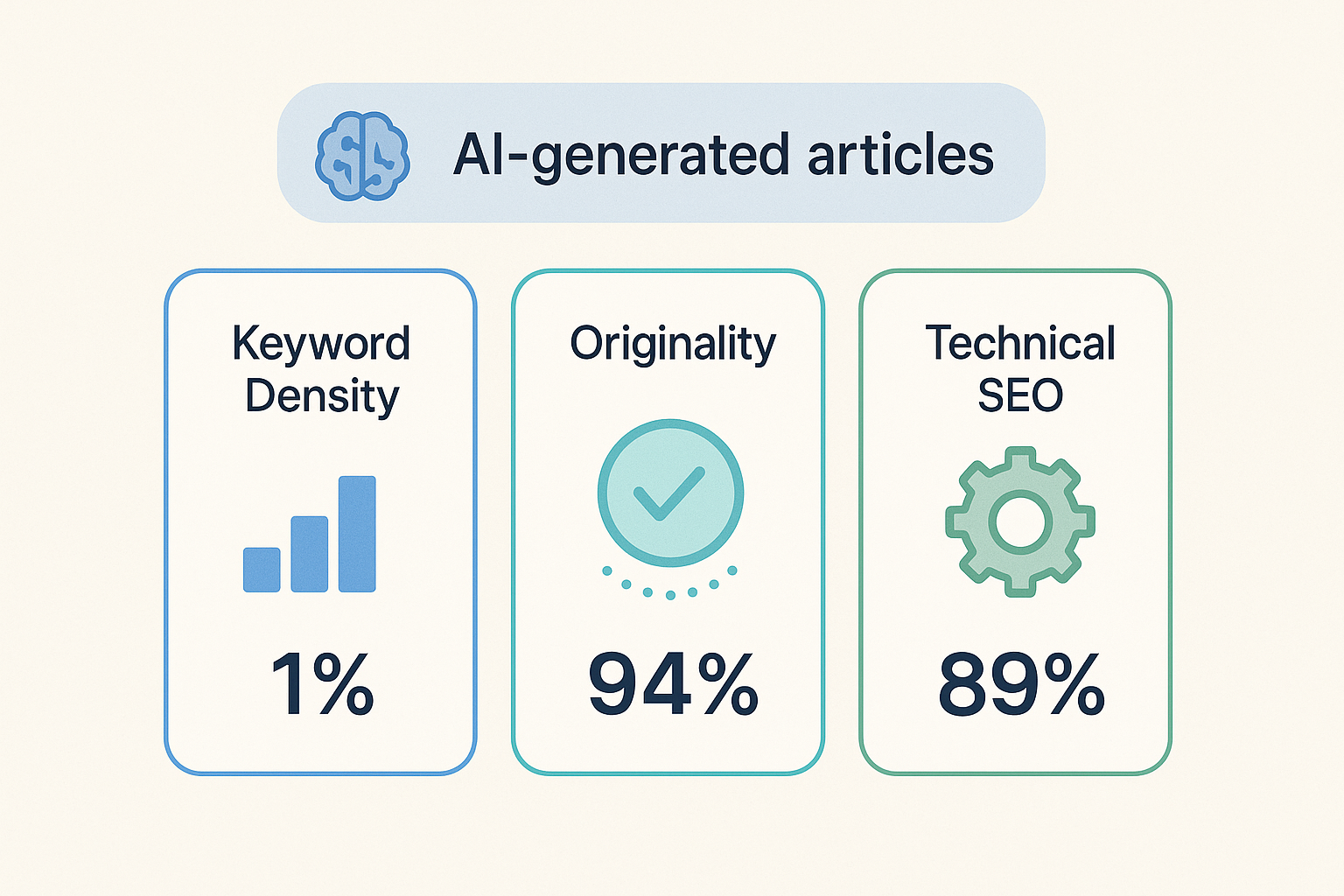
Repeating the exact-match phrase too many times signals manipulation to modern ranking algorithms, which now parse semantic meaning and topical relevance rather than counting keyword frequency. A primary keyword density above 0.5 percent often triggers diminishing returns, especially when the repetition disrupts sentence flow or forces awkward phrasing that a human reader would immediately notice.
Instead, distribute your primary term naturally and rely on related entities, synonyms, and longtail variants to build topical coverage. For example, if your target is "ai content generator for seo," your body text should also mention "automated content creation," "SEO article tools," and "AI-powered copywriting" to map the broader semantic field that Google associates with the core phrase. This approach not only avoids penalties but also captures a wider range of user queries.
Mistake 2: Publishing Thin, Surface-Level Content
Thin content is text that covers a topic without adding depth, specific examples, or actionable advice beyond what a reader could learn from the first paragraph of a Wikipedia entry. AI generators default to this style when prompts lack specificity, resulting in 500-word posts that restate common knowledge without offering original insight, data, or a unique angle.
Search engines now evaluate content depth by comparing your page to the top 10 results for the same query, looking for original sections, unique comparisons, and evidence of subject-matter expertise. If your AI-generated article simply summarizes what every competitor already says, it will struggle to rank even if keyword placement is perfect. To avoid this, inject proprietary data, case study findings, or process breakdowns that only your team can provide, and edit the AI draft to weave those elements throughout the piece.
Mistake 3: Ignoring User Intent and Search Context
A keyword can carry multiple intents, and ranking requires matching the intent Google has already decided to serve for that query. An AI content generator for SEO that targets "best AI SEO tool" with a product comparison will fail if the SERP is dominated by how-to guides, and vice versa.
Before generating a draft, manually review the top five organic results for your target keyword. Note the content format (listicle, tutorial, comparison, definition), the average word count, and the subtopics each page covers. Feed those observations into your prompt or content brief so the generator produces an article that aligns with what users expect when they type that query. Misalignment between format and intent is one of the fastest ways to see high bounce rates and low dwell time, both of which correlate with poor rankings.
Why Do AI-Generated Articles Trigger Duplicate Content Flags?
AI-generated articles trigger duplicate content flags when the same model, using similar prompts, produces nearly identical sentence structures and phrasing across multiple sites or even within the same site. Large language models are probabilistic, so given a common prompt like "write an introduction about AI SEO tools," they will often generate openings that share the same conceptual arc, transition phrases, and vocabulary, even if no two outputs are character-for-character identical.
Google's duplicate detection algorithms look for content fingerprints, not just exact copies. If 70 percent of your sentences match patterns seen across hundreds of other AI-generated pages, the page loses uniqueness value and may be filtered from results or demoted in favor of more original content. The fix is a combination of strong editorial rewriting, specific prompts that reference your unique data or audience, and post-generation checks using tools that compare your draft against indexed pages.
Mistake 4: Neglecting E-E-A-T Signals
Experience, Expertise, Authoritativeness, and Trustworthiness are the four pillars Google uses to evaluate content quality, especially in niches where bad advice can harm the reader. AI-generated text rarely includes first-person case studies, named author credentials, or citations to authoritative sources unless you explicitly instruct the model to add them.
To strengthen E-E-A-T, append an author byline with a brief bio and link to a staff or contributor page. Insert inline references to industry studies, official documentation, or data from your own analytics. If your business has published original research or maintains a knowledge base, link to those assets from the AI-generated article. These signals tell both human readers and ranking algorithms that the content is backed by real expertise, not assembled from scraped training data alone.
Mistake 5: Skipping Internal Linking Strategy
Internal links distribute page authority, guide crawlers to new content, and help users discover related articles, but AI generators often omit them entirely or insert generic anchor text like "click here" that offers no semantic value. Without a clear instruction to reference existing URLs, the model cannot know which pages to link or how to frame the anchor.
Provide the generator with a list of relevant internal URLs and suggested anchor phrases before drafting. For example, if you publish an article on AI SEO automation explained, instruct the model to link that phrase when the topic arises naturally. RankHit automates this step by scanning your existing blog inventory and inserting contextual links during generation, ensuring every new post strengthens your site's link graph without manual editing.
How Can You Identify AI Content That Search Engines May Penalize?
Search engines may penalize AI content that exhibits repetitive phrasing, lacks original data or perspective, and fails to answer the query better than competing pages. A reliable audit starts with reading the article aloud: if sentences sound formulaic or interchangeable with any other article on the topic, the piece is at risk.
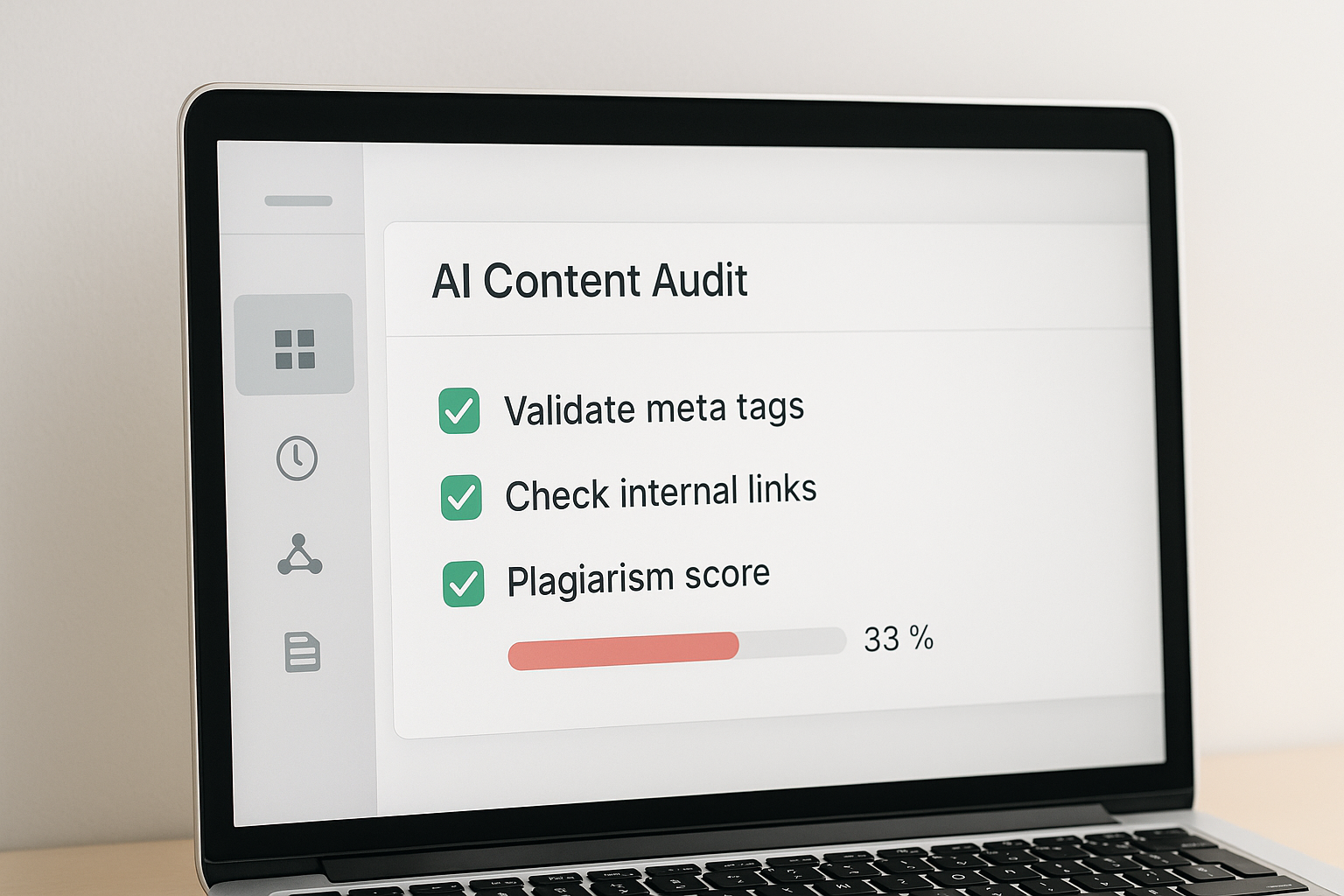
Next, run the draft through a plagiarism checker that compares it against indexed web pages, not just exact duplicates. Look for high similarity scores on sentence clusters, even if no single passage is copied verbatim. Finally, compare the article to the top five SERP results for your target keyword. If your AI draft covers fewer subtopics, omits actionable steps, or provides shallower explanations, it is unlikely to outrank those pages and may be suppressed in favor of more comprehensive content.
Mistake 6: Forgetting to Optimize for Featured Snippets and AI Citations
Featured snippets and AI citation algorithms like ChatGPT's citation engine reward content that delivers direct, self-contained answers in the first sentence of each section. AI generators trained on older content patterns often bury the answer in the third or fourth sentence, leading with context or background instead.
Structure every section so the opening sentence directly answers the heading, as if that sentence were pulled out and displayed alone. Follow with supporting detail, examples, or steps. This pattern not only increases snippet capture but also improves readability and dwell time. RankHit is built for AI search, structuring every article to maximize citation probability in ChatGPT and other LLM-powered tools.
Mistake 7: Publishing Without Human Editorial Review
Publishing AI-generated drafts without editorial review introduces factual errors, outdated information, and tonal inconsistencies that damage trust and brand reputation. Language models do not verify claims against real-time data, so a statement that was true in the training cutoff period may now be false.
Assign a human editor to fact-check statistics, verify links, and ensure the tone matches your brand voice. The editor should also scan for common AI telltale signs such as repetitive transition phrases, vague conclusions, and sections that restate the heading without adding new information. Even a 10-minute review can catch errors that would otherwise erode reader confidence and signal low quality to search algorithms.
What Are the Technical SEO Pitfalls of Automated Content?
Technical SEO pitfalls of automated content include missing meta descriptions, broken internal links, improperly formatted headings, and duplicate title tags when the generator is allowed to publish directly without validation. Each of these issues can prevent a well-written article from ranking, even if the body text is strong.
Before any AI-generated post goes live, verify that the meta description is unique and under 160 characters, that the title tag includes the primary keyword and stays within 60 characters, and that all internal links resolve to live pages. Check heading hierarchy to ensure no H2 is nested under an H4, and confirm that image alt text is descriptive rather than placeholder text. Tools like meta tag checker and canonical tag checker can automate this validation step and flag errors before publication.
Mistake 8: Over-Optimizing for One Keyword at the Expense of Semantic Breadth
Focusing too narrowly on a single keyword limits the page's ability to rank for related queries and reduces its topical authority. Modern search algorithms reward pages that comprehensively cover a topic cluster, not just a single phrase.
Map out secondary and tertiary keywords that belong to the same semantic family, and ensure your AI-generated content addresses those variations naturally. For instance, an article targeting "ai content generator for seo" should also touch on "automated SEO content creation," "AI blog writer," and "SEO article generator" in ways that answer distinct but related questions. This approach expands your potential query matches and signals to Google that your page is a comprehensive resource rather than a narrow, keyword-focused stub.
Mistake 9: Treating AI Output as the Final Draft
AI output should be treated as a first draft that requires editing, fact-checking, and enhancement with brand-specific insights. Models generate plausible-sounding text based on patterns, not verified truth, so they can confidently assert outdated statistics or invent details that sound credible but have no source.
Use the AI draft as a structural skeleton: keep the headings, outline, and flow, but rewrite sections where the model was vague or generic. Add real examples from your customer base, quote internal data, and link to authoritative external sources where appropriate. This hybrid approach combines the speed of automation with the accuracy and originality that only human expertise can provide, resulting in content that performs well in both traditional search and AI-powered answer engines.
How Do You Build a Quality Control Process for AI-Generated SEO Content?
Building a quality control process for AI-generated SEO content starts with a checklist that every draft must pass before publication: keyword density within target range, heading hierarchy validated, internal links inserted with descriptive anchors, meta tags unique and complete, and at least one round of human editing completed. Each checklist item should have a named owner and a clear pass/fail criterion.
Next, establish a post-publication audit cycle. Two weeks after an AI-generated article goes live, review its performance in Google Search Console: impressions, clicks, average position, and bounce rate. If the page underperforms, identify the gap (thin content, poor intent match, weak internal linking) and update the article accordingly. This feedback loop trains your team to recognize patterns in what works and what fails, gradually improving the quality of future AI prompts and editorial guidelines.
| Mistake | Risk Level | Primary Fix |
|---|---|---|
| Keyword Stuffing | High | Cap density at 0.5%, use semantic variants |
| Thin Content | High | Add proprietary data, expand depth by 30% |
| Mismatched Intent | High | Audit SERP format before drafting |
| Duplicate Patterns | Medium | Run plagiarism check, rewrite generic sections |
| Weak E-E-A-T | Medium | Add author byline, cite authoritative sources |
| Missing Internal Links | Medium | Provide URL list, use descriptive anchors |
| No Snippet Optimization | Low | Lead each section with direct answer |
| Skipping Editorial Review | High | Assign human editor to fact-check and refine |
| Technical SEO Gaps | Medium | Validate meta tags, links, heading hierarchy |
Can AI Content Generators Help with Topical Authority?
AI content generators can accelerate topical authority building when used to produce a comprehensive cluster of interlinked articles that cover every facet of a subject, from foundational concepts to advanced techniques and case studies. Topical authority is the cumulative signal Google derives from a site that consistently publishes deep, well-structured content on a narrow niche, and automation lets you reach critical mass faster than manual writing.
However, the generator must be guided by a topical map that identifies all subtopics, their relationships, and the internal linking structure that will bind them. Publishing 50 disconnected AI articles on loosely related keywords will not build authority; publishing 50 articles that form a coherent hub-and-spoke architecture, with pillar pages linking to supporting posts and vice versa, will. RankHit includes a topical map generator and automatically handles internal linking across the entire cluster, turning raw AI output into a coordinated topical authority strategy.

What Role Does Prompt Engineering Play in Content Quality?
Prompt engineering determines content quality by specifying structure, depth, tone, and sourcing constraints that guide the model toward output aligned with your SEO goals. A vague prompt like "write about AI SEO tools" yields a generic introduction and shallow bullet points, while a detailed prompt that includes target word count, required subtopics, internal link URLs, and tone instructions produces a draft much closer to publication-ready.
Effective prompts also set boundaries: instruct the model not to invent statistics, to flag any claim it cannot verify, and to cite placeholder references that a human editor can later replace with authoritative sources. The more specific your constraints, the less post-generation editing is required and the lower the risk of publishing content that harms your site's credibility or ranking.
How Do You Balance Automation Speed with Content Originality?
Balancing automation speed with content originality requires a hybrid workflow where AI handles structure, research synthesis, and first-draft writing, while humans add proprietary insights, brand voice, and fact verification. This division of labor preserves the efficiency gains of automation without sacrificing the unique perspective that differentiates your content from competitors.
Set a rule that no AI draft is published without at least two unique elements added by a human: a case study, a data point from internal analytics, a customer quote, or a process diagram. These additions take minutes but transform a generic article into one that only your business could have written, significantly improving both user engagement and search performance.
Frequently Asked Questions
Does Google penalize all AI-generated content?
Google does not penalize content solely because it was generated by AI, but it does penalize content that is low quality, duplicative, or created primarily to manipulate search rankings regardless of how it was produced. The search engine's guidelines focus on whether content is helpful, reliable, and people-first, not the tool used to create it. AI-generated articles that meet quality standards, provide original value, and satisfy user intent can rank as well as human-written pieces.
How often should I audit AI-generated SEO content for quality issues?
Audit AI-generated SEO content immediately before publication and again two to four weeks after it goes live to catch both pre-launch technical errors and post-launch performance gaps. The first audit checks for keyword density, internal links, meta tags, and factual accuracy, while the second reviews Google Search Console metrics to identify pages with high impressions but low clicks, high bounce rates, or stagnant rankings that signal content quality problems.
Can an AI content generator for SEO replace a human writer entirely?
An AI content generator for SEO cannot fully replace a human writer if the goal is to produce high-quality, original content that builds trust and authority. AI excels at drafting structure, summarizing research, and maintaining consistent output speed, but it lacks the ability to inject brand-specific insights, verify real-time data, or craft a unique voice that resonates with a target audience. The most successful workflows treat AI as a drafting assistant that accelerates production while humans provide editorial judgment, fact-checking, and creative differentiation.
What is the ideal keyword density for AI-generated articles?
The ideal keyword density for AI-generated articles falls between 0.4 percent and 0.5 percent of total word count, which translates to roughly six to nine natural mentions of the primary keyword in a 1,500 to 1,800-word piece. Exceeding this range risks triggering keyword stuffing penalties, while falling below it may result in weaker topical relevance signals. Balance exact-match keywords with semantic variants and related terms to build comprehensive topical coverage without over-optimization.
How do I prevent duplicate content when scaling AI content production?
Prevent duplicate content when scaling AI production by maintaining a content inventory that tracks all published topics and keywords, using unique prompts that reference your brand's specific data or audience for each article, and running every draft through a plagiarism checker before publication. Also vary the article structure and angle for closely related keywords so that even if two pieces target similar queries, they approach the topic from different perspectives and deliver distinct value to the reader.
Avoiding these nine mistakes transforms an AI content generator for SEO from a source of risky, low-quality output into a strategic asset that accelerates your editorial calendar while maintaining the quality standards search engines and readers demand. The key is recognizing that automation handles the repetitive, time-consuming tasks of research, drafting, and formatting, but human oversight remains essential for originality, accuracy, and strategic alignment. By building a disciplined quality control process, crafting specific prompts, and treating AI output as a first draft rather than a finished product, you can scale SEO content production without sacrificing the depth and trust that drive long-term rankings and conversions. Explore how RankHit works to see how automated keyword research, internal linking, and native publishing integrate into a single workflow designed to help your site rank on Google and get cited by ChatGPT.

RankHit
RankHit official
RankHit researches keywords, writes SEO articles, and publishes them on autopilot so brands can rank on Google and get cited by ChatGPT.