AI SEO Automation: Complete Guide to Scaling Content in 2025
Discover how AI SEO automation works, which tools deliver results, and how to scale your content strategy without sacrificing quality or rankings.

AI SEO automation transforms how websites publish content at scale by combining machine learning with traditional search optimization principles, enabling businesses to produce dozens or hundreds of pieces monthly without expanding their teams.
The technology handles keyword research, content drafting, internal linking, and even publishing workflows end to end. For small teams and startups chasing traffic goals between 100 and 1,000 monthly visitors, automation closes the gap between ambition and execution capacity, replacing the weeks-long manual process with a system that delivers publication-ready drafts in hours.
What Is AI SEO Automation?
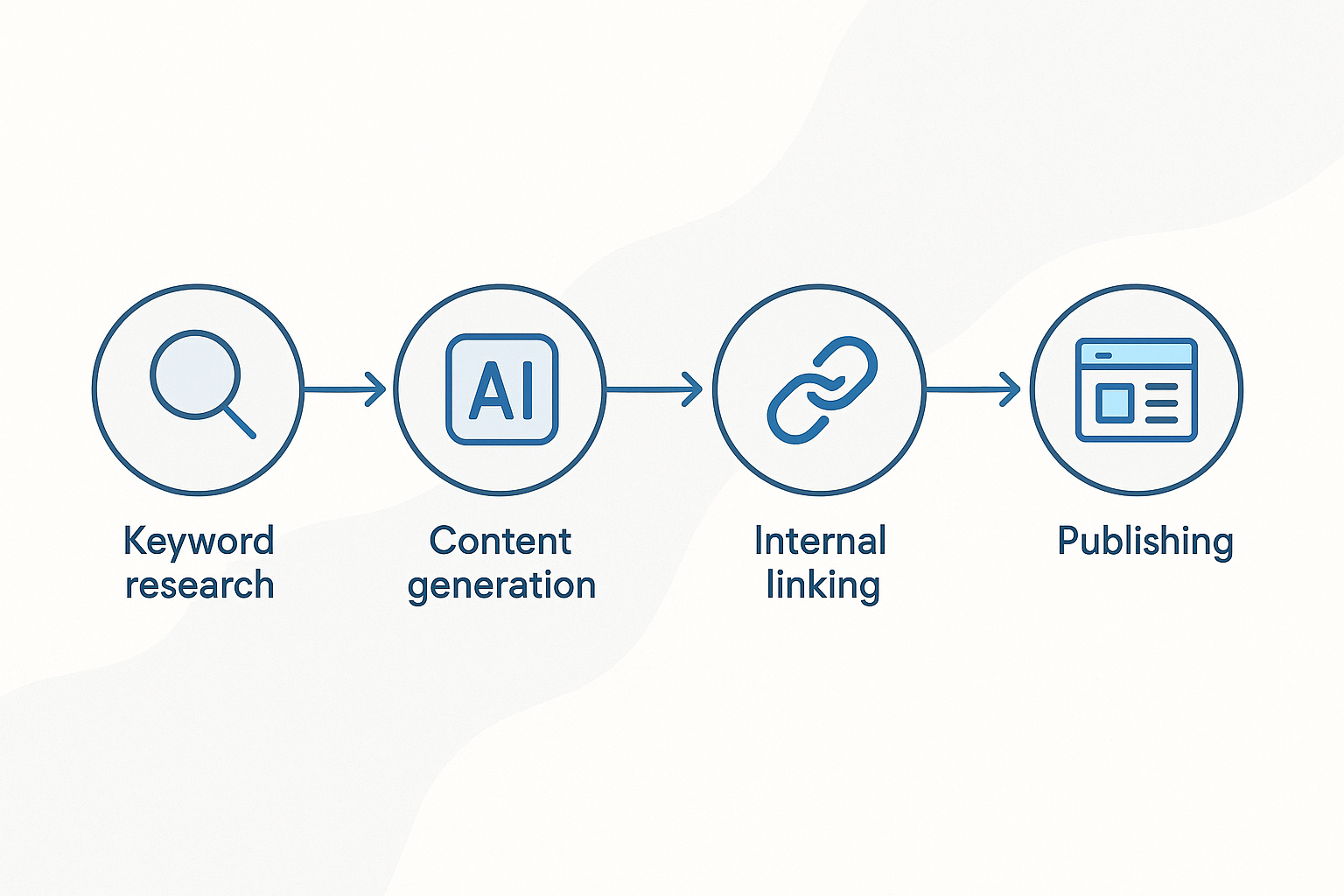
AI SEO automation refers to software that uses large language models and machine learning algorithms to execute repeatable search engine optimization tasks without human intervention for every step. Instead of manually researching keywords, outlining articles, writing drafts, inserting links, and uploading to a content management system, the platform handles each phase in sequence once you define the target topic or keyword set.
Most platforms operate in distinct modules: keyword discovery pulls semantic variants and long-tail phrases from live search data, content generation synthesizes those keywords into structured articles optimized for readability and ranking factors, internal linking engines suggest contextual anchor placements across your existing site structure, and native publishing connectors push final drafts directly into WordPress or other CMSs. The result is a single workflow replacing four separate manual jobs.
How Does AI SEO Automation Actually Work?
Automation platforms ingest a seed keyword or topic, then query databases of search trends to surface related phrases people actually type into Google and AI assistants. The system ranks those phrases by search volume, competition, and semantic relevance, building a prioritized list that informs which content to create next.
Once keywords are selected, the platform generates a content brief, an outline that maps headings, target word count, and the placement of primary and longtail keywords across sections. A large language model trained on SEO best practices then writes the first draft, structuring paragraphs to answer common questions, incorporating schema markup cues, and suggesting image placements. Internal linking algorithms scan your existing blog inventory and identify anchor opportunities, inserting contextual links that build topical clusters without manual cross-referencing.
Finally, publishing modules connect via API to WordPress, Webflow, or other platforms, uploading the HTML, setting meta tags, scheduling publication dates, and even submitting sitemaps to search consoles, completing the entire cycle from keyword to indexed page without touching a text editor.
Why Teams Choose AI SEO Automation Over Manual Content
Speed is the primary driver. A writer producing one comprehensive blog post per week delivers four articles monthly, while an AI SEO automation tool can generate that same volume in a single afternoon, freeing the writer to focus on editing, strategy, and high-value tasks that require human judgment.
Consistency ranks second. Manual workflows introduce variability in tone, keyword density, heading structure, and internal link placement as different contributors interpret guidelines differently. Automation enforces uniform standards across every piece, ensuring every article meets minimum on-page SEO thresholds without quality-control bottlenecks.
Cost efficiency follows closely. Hiring a full-time SEO writer or agency retainer for 20 posts per month can run thousands of dollars, whereas most AI SEO automation tools operate on subscription models priced at a fraction of that expense, delivering comparable or greater output volume without incremental labor costs as you scale.
What Tasks Should You Automate First?
Begin with keyword research and content brief generation, the two steps that consume the most time in traditional workflows yet offer the highest tolerance for machine execution. Automating these phases alone cuts planning overhead by half, letting your team move from concept to outline in minutes instead of hours.
Next, automate internal linking if your site already has a catalog of 20 or more published posts. Manual cross-linking becomes exponentially harder as your library grows, and missing links directly harms topical authority. AI tools scan your full inventory and suggest anchors based on semantic overlap, building cluster networks that would take weeks to map by hand.
| Task | Manual Time | Automated Time | Automation Priority |
|---|---|---|---|
| Keyword research | 2-4 hours | 5-10 minutes | High |
| Content brief creation | 1-2 hours | 3-5 minutes | High |
| Draft writing | 3-6 hours | 10-20 minutes | Medium |
| Internal linking | 30-60 minutes | 2-5 minutes | High |
| Publishing and formatting | 20-40 minutes | Instant | Medium |
Core Components of AI SEO Automation Tools
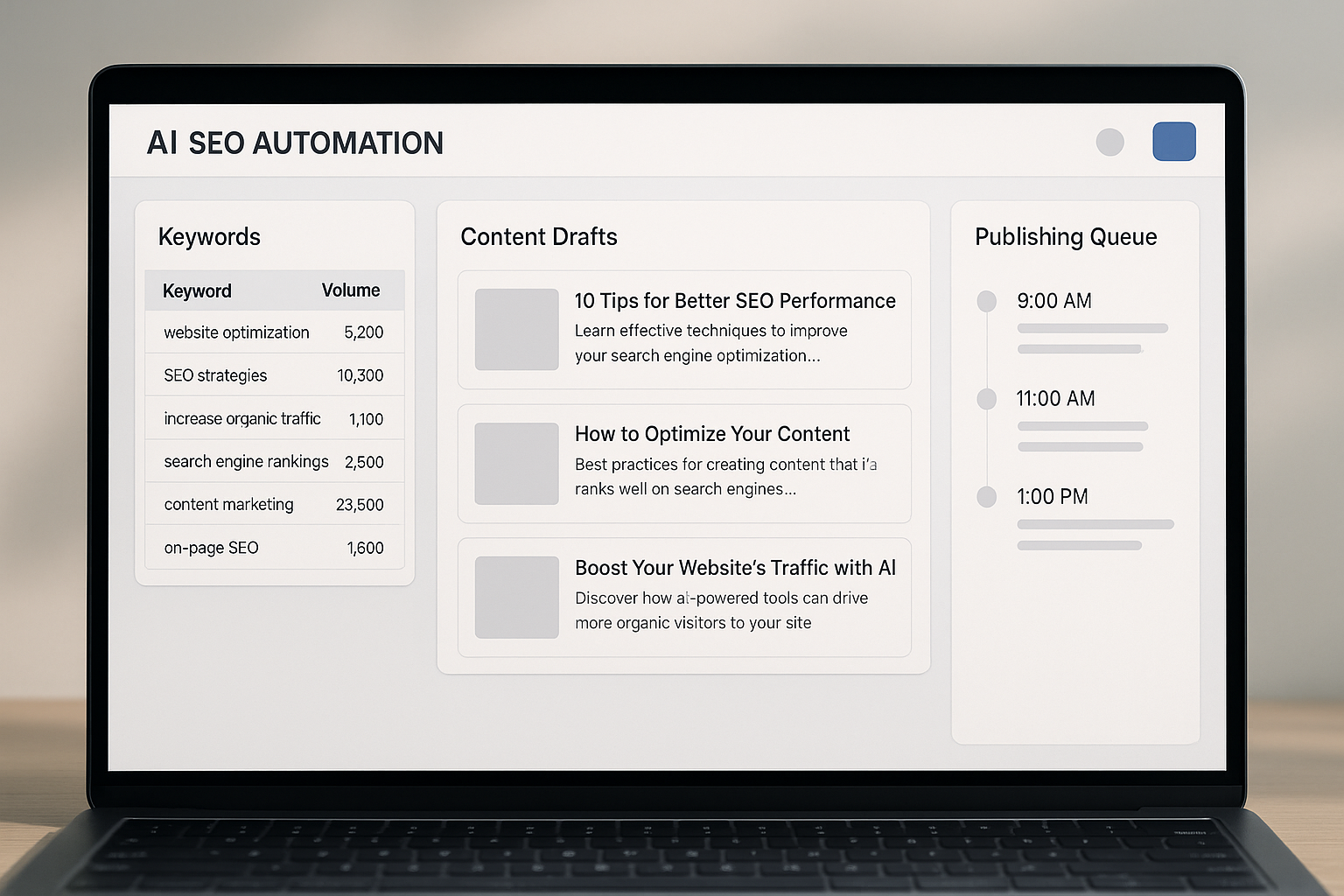
Every effective platform includes four foundational modules working in concert to replicate the full SEO content lifecycle.
Keyword Research Engine
The keyword engine pulls live data from search APIs, question databases, and competitor analysis sources, identifying terms your audience searches for alongside volume estimates and difficulty scores. Advanced systems also flag opportunities for AI search citations, surfacing phrases that language models like ChatGPT frequently reference when answering user queries, a critical factor as generative search grows.
Content Generation Module
The generator takes brief inputs and produces structured HTML or Markdown drafts, complete with headings, bullet lists, tables, and FAQ sections. The best tools let you define tone, word count targets, and keyword density thresholds, then apply those constraints consistently across every article to maintain brand voice and SEO rigor.
Internal Linking Intelligence
Linking modules analyze your published inventory and suggest anchor placements that reinforce topical clusters, passing authority from older posts to newer ones and guiding crawlers through semantic pathways. This capability becomes indispensable once you publish beyond 30 articles, the point where manual linking memory fails.
Native Publishing Connector
Publishing connectors integrate directly with your CMS, uploading drafts as posts or pages, assigning categories and tags, inserting meta descriptions and canonical tags, and optionally scheduling publication. This native integration eliminates copy-paste errors and versioning confusion, ensuring what the AI generates is exactly what goes live.
How to Choose AI SEO Automation Tools That Fit Your Workflow
Start by auditing which tasks currently bottleneck your content pipeline, whether that is keyword discovery, drafting speed, or publishing logistics. Choose a platform whose strongest module addresses your biggest pain point rather than picking the tool with the longest feature list.
Evaluate how deeply the tool integrates with your existing stack. If you publish exclusively on WordPress, prioritize solutions offering native WordPress connectors over those requiring CSV exports and manual uploads. If your team already uses Ahrefs or SEMrush for keyword data, confirm the automation tool can import that data or offers comparable research depth to avoid paying for redundant subscriptions.
Test output quality on a small batch before committing. Most platforms offer free trials or low-tier plans; run a handful of articles through the system, review keyword placement, heading structure, readability, and factual accuracy, then compare those drafts to your manual baseline. The gap between AI output and publication-ready quality determines how much editing labor you still carry, the true cost beyond subscription fees.
Can AI SEO Automation Replace Human Writers?
AI SEO automation replaces repetitive execution, not strategic thinking or subject matter expertise. The technology excels at drafting explainer content, listicles, how-to guides, and FAQ articles where structure and keyword coverage matter more than narrative voice or original research.
Human writers remain essential for thought leadership, case studies, product announcements, and any content requiring interviews, proprietary data interpretation, or brand storytelling that a machine cannot infer from publicly available text. The highest-performing content strategies pair automation for volume and consistency with human editing for quality control and differentiation, letting writers focus on the 20 percent of content that drives 80 percent of business outcomes.
What Are the Risks of Automating SEO Content?
The primary risk is publishing generic, undifferentiated content that fails to rank because thousands of other sites used similar tools to target the same keywords with near-identical outlines. Search engines reward depth, originality, and user value; if your automated output reads like every competitor's automated output, you gain no ranking advantage despite higher volume.
Factual errors present a second concern. Language models generate plausible text but sometimes fabricate statistics, misattribute quotes, or state outdated information as current fact. Every automated draft requires human review to verify claims, update references, and correct hallucinations before publication.
Over-optimization can trigger quality filters. Keyword stuffing, thin content, and formulaic structure all hurt rankings when taken to extremes. Automation makes it easy to publish 50 articles in a week, but if those articles lack substantive value or repeat the same template with minor keyword swaps, search algorithms will deprioritize your domain for low-effort spam patterns.
How Does AI SEO Automation Impact Rankings and Traffic?
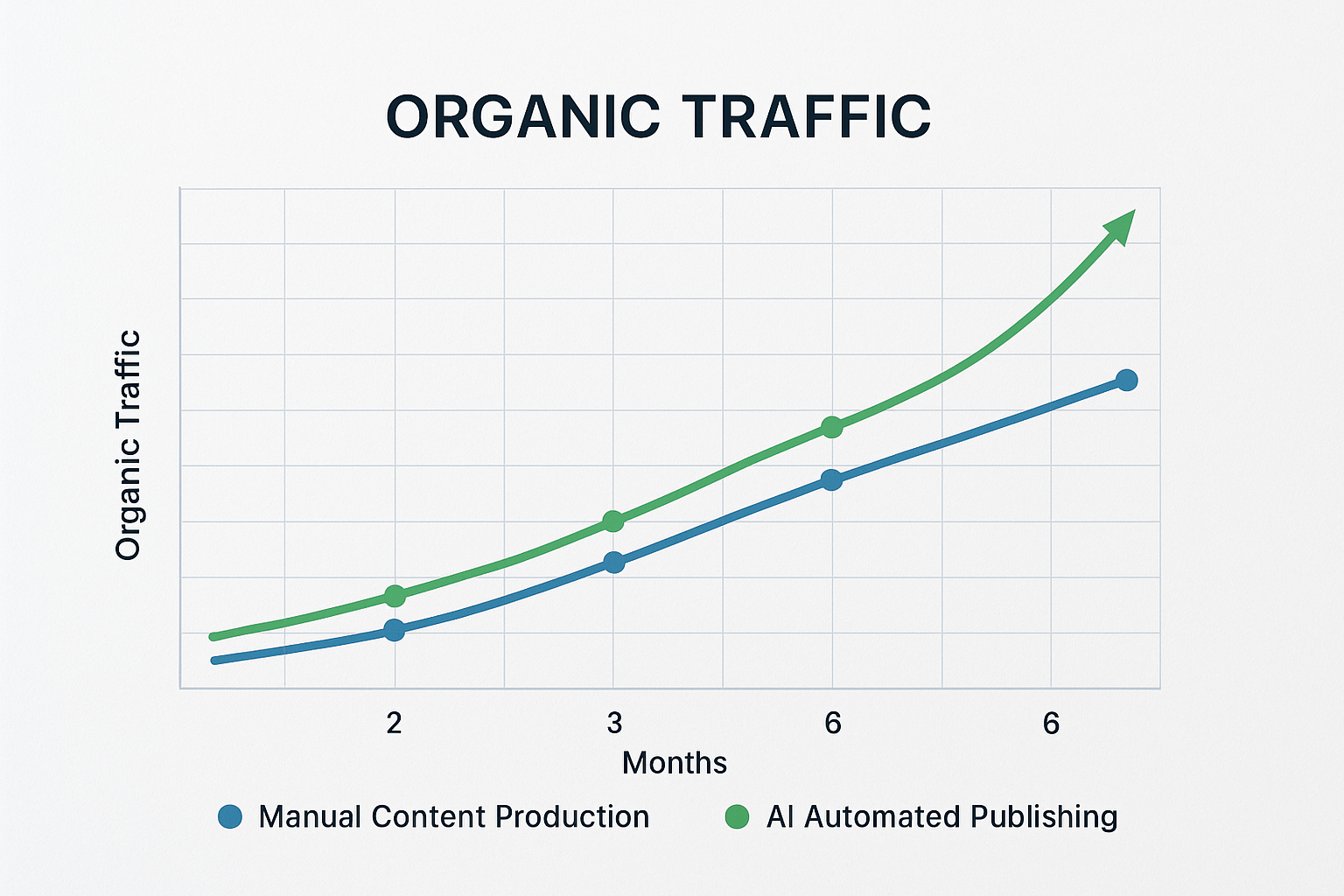
Automation accelerates the timeline to critical mass, the point where your site has enough topical coverage to compete for cluster rankings and featured snippets. Reaching 50 to 100 articles in a niche typically takes a manual team six months to a year; automation can compress that to eight to twelve weeks, letting you capture long-tail traffic sooner.
However, volume alone does not guarantee traffic. The articles must satisfy search intent, load quickly, earn backlinks, and outperform existing results on depth or freshness. Automation provides the substrate, the raw volume of optimized pages, but ranking success still depends on topic selection, content differentiation, and technical SEO health.
Sites using AI SEO automation tools often see initial traffic gains plateau after three to six months unless they layer in link building, content refreshes, and user engagement optimization. Treat automation as the foundation, not the entire strategy.
Integrating AI SEO Automation with Your Existing Content Calendar
Start by designating specific content types for automation, such as glossary entries, comparison posts, or seasonal guides, while reserving high-value cornerstone content for manual creation. This segmentation lets you scale output without diluting brand voice on flagship pieces.
Build a review checkpoint between generation and publishing. Assign an editor to fact-check, refine tone, and add proprietary insights to every automated draft, transforming generic output into differentiated content before it goes live. This step adds labor but preserves quality, preventing your site from becoming a repository of indistinguishable AI text.
Sync your automation tool with your editorial calendar by batching keyword research and brief generation at the start of each month, then scheduling drafts to publish on a consistent cadence. Consistent velocity signals to search engines that your site is actively maintained, which can improve crawl frequency and indexing speed for new pages.
Setting Up Your First AI SEO Automation Workflow
Begin by connecting your chosen platform to your CMS and analytics accounts so the tool can access existing content and track performance. Most platforms guide you through OAuth authorization flows or API key entry during onboarding.
Next, define your target keyword list. Upload a seed set of 10 to 20 primary topics relevant to your business, then let the automation engine expand those into 100 or more longtail variants. Review the expanded list and filter out irrelevant terms or those with zero search volume to keep your pipeline focused.
Configure content parameters such as tone, word count range, heading density, and keyword placement rules. If your platform supports custom instructions, add brand-specific guidelines like prohibited jargon, required disclosures, or regional spelling preferences to ensure output aligns with your style guide.
Generate a test batch of three to five articles, review them line by line, and refine your parameters based on what needs correction. Iterate this loop until the first draft quality meets your minimum acceptable threshold, then scale to weekly or daily publishing schedules.
How Long Does It Take to See Results from AI SEO Automation?
Expect a lag of four to twelve weeks between publishing and measurable traffic, the typical indexing and ranking window for new content in moderately competitive niches. High-authority domains with frequent crawl rates may see impressions within two weeks, while newer sites can wait three months before pages break into top 50 positions.
The compounding effect accelerates over time. Your first 10 articles might drive only a trickle of visits, but as you publish 30, then 50, then 100, internal links strengthen topical clusters, and search engines begin treating your domain as an authority on those subjects, lifting rankings across the entire content set.
Measuring ROI on AI SEO Automation Investments
Calculate cost per article by dividing your monthly subscription fee plus editing labor hours by total articles published. Compare that figure to your previous cost per manually written post, typically the sum of writer fees, editor time, and project management overhead.
Track organic traffic and conversion metrics separately for automated content versus manual content using UTM parameters or content grouping in analytics. If automated posts convert at a lower rate, adjust your workflow to add more human polish or reserve automation for top-of-funnel awareness content rather than bottom-of-funnel conversion pages.
Monitor time savings as a soft ROI metric. If your team previously spent 40 hours per month on content production and automation reduces that to 10 hours of review and editing, those reclaimed 30 hours represent capacity you can reallocate to link outreach, product development, or customer success initiatives that drive revenue directly.
Optimizing AI-Generated Content for ChatGPT and AI Search Citations
AI search engines like ChatGPT, Perplexity, and Google SGE cite sources that answer queries concisely and authoritatively, favoring content structured as direct answers followed by supporting detail. Format your automated articles with clear, standalone opening sentences under each heading, making it easy for language models to extract quotable snippets.
Include schema markup for FAQs, how-tos, and articles. Many AI SEO automation tools generate schema automatically, but verify it appears in your page source and validates without errors using Google's Rich Results Test. Structured data helps AI systems parse your content semantically, increasing citation likelihood.
Prioritize factual accuracy and cite credible sources when making claims. Language models cross-reference information during training and inference; content that contradicts consensus or lacks supporting evidence gets deprioritized. Even automated drafts should link to authoritative external references where appropriate, signaling reliability to both human readers and AI systems.
Platforms like RankHit specifically optimize for AI search citations by structuring content to meet the query patterns and answer formats that generative models prefer, increasing the chance your pages get cited when users ask questions in ChatGPT or other AI assistants.
Common Mistakes to Avoid with AI SEO Automation
Publishing without human review is the most damaging error. Even sophisticated models produce factual mistakes, awkward phrasing, and logical gaps that harm credibility and rankings. Treat every automated draft as a first pass requiring editorial oversight before going live.
Ignoring brand voice leads to generic content indistinguishable from competitors. Configure tone settings, inject proprietary examples, and edit introductions and conclusions to reflect your unique perspective, ensuring readers recognize your brand even in automated pieces.
Over-relying on a single keyword set creates topical silos that limit growth. Regularly refresh your keyword research, exploring adjacent topics and emerging search trends, so your automated content pipeline evolves with audience interests rather than stagnating on last quarter's priorities.
Neglecting internal links between automated articles and your existing library weakens topical authority. Use your platform's linking intelligence to retroactively add anchors from older posts to new ones, building bidirectional pathways that distribute authority and guide users through related content.
Frequently Asked Questions
Does Google penalize AI-generated content?
Google does not penalize content solely because it was created by AI; the search engine evaluates quality, relevance, and user value regardless of authorship method. Low-quality, spammy, or misleading content gets penalized whether human or machine-written, so focus on producing helpful, accurate articles that satisfy search intent rather than worrying about the tool you use to draft them.
How much does AI SEO automation cost?
AI SEO automation tools range from budget-friendly plans starting around a few dollars per month for basic keyword research and content generation to enterprise tiers exceeding several hundred dollars monthly for unlimited publishing, advanced integrations, and dedicated support. The total cost depends on your monthly article volume, feature requirements, and whether you need native CMS publishing or can work with exported drafts.
Can small businesses benefit from AI SEO automation?
Small businesses gain disproportionate value from AI SEO automation because they often lack the budget to hire full-time writers or retain agencies, yet still need consistent content to compete in search. Automation lets a solo founder or lean team publish weekly or even daily without sacrificing product development or customer service time, closing the content gap against better-funded competitors.
What is the difference between AI content generators and AI SEO automation platforms?
AI content generators produce draft text from prompts but leave keyword research, optimization, internal linking, and publishing as separate manual tasks. AI SEO automation platforms integrate the entire workflow, handling keyword discovery, brief creation, draft generation, link insertion, and CMS upload in one connected system, eliminating the handoffs and data transfers that slow down manual pipelines.
How do I ensure automated content matches my brand voice?
Configure tone settings in your automation platform to specify formality level, sentence structure preferences, and vocabulary choices, then provide example articles that exemplify your voice. Most advanced tools let you upload style guides or sample posts as reference, training the model to mimic your brand's unique phrasing, and always edit introductions and conclusions manually to inject personality that pure automation cannot replicate.
AI SEO automation works best when treated as a force multiplier for human strategy rather than a replacement for editorial judgment. Define your content goals, choose tools that integrate seamlessly with your existing workflow, review every draft before publishing, and measure performance continuously. The combination of machine efficiency and human oversight delivers both scale and quality, positioning your site to capture traffic growth without the unsustainable labor costs of purely manual production.
Whether you are targeting 100 monthly visitors or 1,000, the fundamentals remain constant: publish consistently, optimize for search intent, build topical authority through internal linking, and ensure every page delivers genuine value. Automation handles the repetitive execution, freeing your team to focus on strategy, differentiation, and the creative work that turns traffic into customers.
Explore how platforms like RankHit streamline keyword research, content creation, internal linking, and publishing into a single automated workflow, or review the step-by-step process on the how it works page. For teams ready to scale, the AI topical map generator helps identify keyword clusters worth automating first, while the SEO revenue calculator quantifies the ROI potential before you commit. If you are comparing options, the AI SEO tool comparison guide walks through feature sets and use cases across leading platforms, and the SEO content automation ROI article breaks down the numbers behind time savings and traffic gains.

RankHit
RankHit official
RankHit researches keywords, writes SEO articles, and publishes them on autopilot so brands can rank on Google and get cited by ChatGPT.