AI SEO Software Buyer's Checklist: Generative vs Traditional
Use this buyer's checklist to choose the best AI SEO software, comparing generative AI platforms against traditional tools for your workflow.

Choosing AI SEO software requires a structured evaluation process that accounts for the fundamental difference between generative AI platforms and traditional optimization tools, a distinction that directly affects your team's workflow, content velocity, and ability to rank in both Google search and AI-driven answer engines like ChatGPT.
The stakes are high: traditional AI SEO software platforms typically add intelligence to manual tasks you already perform, while generative AI SEO software automates entire workflows from keyword research through publishing. This buyer's checklist walks you through the eight decision points that matter most, helping you match platform architecture to your actual business needs rather than feature lists alone.
What separates generative AI SEO software from traditional AI tools?
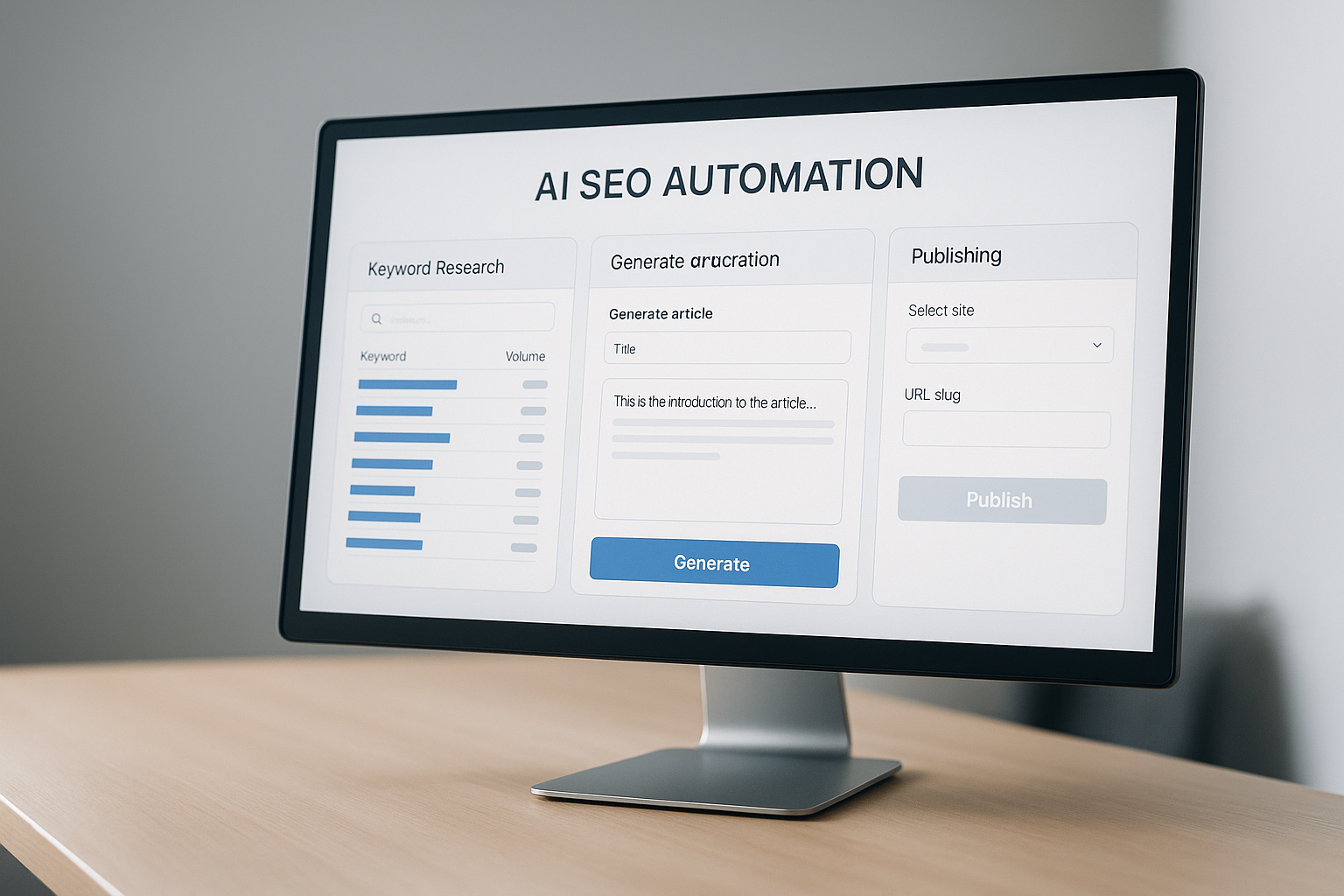
Generative AI SEO software produces original content assets and executes multi-step workflows autonomously, while traditional AI SEO software analyzes data and recommends actions you still execute manually. Traditional tools might surface keyword opportunities or score your on-page optimization, but a human still writes the article, builds the internal link structure, and publishes the result. Generative platforms like RankHit handle the entire chain: research, drafting, linking, and publishing to your CMS without requiring you to switch contexts or copy-paste between tools.
This architectural difference cascades into every evaluation criterion below. A traditional tool might be sufficient if you already have a content team and need better data; a generative platform makes sense when you need to scale content production beyond what human bandwidth allows, or when you want to eliminate the manual handoffs that slow down publication velocity.
Core capability checklist: automation depth
Automation depth measures how many steps in the SEO content lifecycle the platform completes without human intervention. Start by listing every task your team performs today, from keyword research and content brief creation through article drafting, internal linking, meta tag writing, and CMS publishing. Then score each prospective platform on how many of those steps it fully automates versus how many it only assists with recommendations.
| Workflow stage | Traditional AI tool | Generative AI platform |
|---|---|---|
| Keyword research | Suggests keywords | Selects and prioritizes keywords automatically |
| Content brief | Generates brief template | Creates brief and executes it |
| Article drafting | Provides outline or suggestions | Writes full draft to specification |
| Internal linking | Recommends link opportunities | Inserts contextual links automatically |
| Publishing | Requires manual CMS upload | Publishes directly to WordPress or other CMS |
Platforms with deeper automation reduce the number of tools in your stack and the number of handoffs between team members, which directly accelerates your content velocity. If your bottleneck is production capacity rather than strategy, prioritize generative capabilities over analytical depth.
How many integrations does the platform require to complete a workflow?
The best AI SEO software minimizes the number of third-party tools you need to connect to publish a finished article. Traditional platforms often require separate integrations for keyword data, content creation, grammar checking, plagiarism scanning, and CMS publishing, each adding configuration overhead and potential points of failure. Generative platforms like RankHit consolidate these steps into a single pipeline, handling research, drafting, internal linking, and native publishing to WordPress without requiring you to manage API keys or middleware.
Count the number of logins, dashboards, and data export steps required to take one keyword from research to a live article on your site. If the answer is more than two, that friction will compound as you scale, slowing down your publishing cadence and increasing the chance that tasks fall through the cracks.
Does the platform optimize for AI search citations?
AI search engines like ChatGPT, Perplexity, and Google SGE cite sources differently than traditional blue-link search results, prioritizing structured data, direct answers, and content formatted for extraction. A platform optimized for AI search structures articles with schema markup, FAQ sections, and answer-first paragraph formatting that increases the likelihood your content gets cited when a user asks a question in an AI interface.
Most traditional AI SEO software was built before large language models reshaped search behavior, so their output templates prioritize keyword density and backlink signals over citation-friendly formatting. Look for platforms that explicitly mention AI search optimization or built-for-AI-search architecture, and review sample outputs to confirm they include structured question-and-answer formatting, not just keyword-stuffed paragraphs.
Pricing model: per-article vs subscription vs usage-based
Pricing structure reveals how the vendor expects you to scale and what behavior they incentivize. Per-article pricing offers predictability but penalizes high-volume publishers. Flat subscription models work well if you publish consistently each month but waste budget during slower periods. Usage-based pricing aligns cost with actual output, letting you scale up during content sprints and scale down without burning unused credits.
Compare the effective cost per published article at three volume levels: your current monthly output, double that output, and ten times that output. If the cost curve becomes prohibitive at higher volumes, the platform will constrain your growth. If the platform charges separately for keyword research, drafting, and publishing, add those line items together to calculate true per-article cost, since unbundled pricing often hides the total expense until after you commit.
What happens to your content if you stop paying?
Vendor lock-in risk varies by platform architecture. Tools that publish directly to your WordPress site leave the content on your domain even if you cancel, while platforms that host content on their own subdomain or require ongoing access fees to keep articles live create dependency. Check whether the platform provides bulk export in standard formats and whether published articles remain on your CMS without requiring the tool's continued involvement.
Content quality and editorial control
Generative AI SEO software produces drafts at scale, but quality control mechanisms determine whether those drafts meet your brand standards without requiring full rewrites. Evaluate how much control you retain over tone, structure, keyword density, and factual grounding. The best platforms let you set content guidelines once and apply them consistently across all future articles, while weaker tools require manual prompt engineering for every piece.
Request sample outputs using your own keywords and compare them against articles your team has written manually. Look for factual accuracy, natural keyword integration, proper heading hierarchy, and whether the tone matches your brand voice. If the sample reads generic or stuffed with keywords, no amount of manual editing will make the platform efficient at your target volume.
Can you customize content templates and workflows?
Customization depth separates platforms that serve one use case well from those that adapt to diverse content strategies. Fixed templates lock you into a single article structure, while flexible platforms let you define custom outlines, adjust word count ranges, specify internal linking rules, and set brand-specific vocabulary. If you publish multiple content types (blog posts, landing pages, product descriptions), confirm the platform supports distinct templates for each rather than forcing every output into the same format.
Keyword research and topical authority
Traditional AI SEO software typically pulls keyword suggestions from third-party databases like Ahrefs or SEMrush, while generative platforms increasingly combine database lookups with semantic analysis to identify topic clusters and content gaps. Topical authority (publishing comprehensively on related subtopics rather than isolated keywords) signals expertise to both Google and AI search engines, so platforms that map keyword relationships and suggest content clusters deliver better long-term ranking outcomes than those that treat each keyword in isolation.
Ask whether the platform identifies semantic relationships between keywords, suggests supporting subtopics for pillar content, and tracks your coverage of a topic cluster over time. Tools that only provide search volume and difficulty scores leave strategic planning to you, while platforms with topical authority mapping accelerate your path to comprehensive coverage.
Does the tool surface long-tail opportunities automatically?
Long-tail keywords drive more qualified traffic and face less competition than broad terms, but discovering them manually is time-intensive. The best generative AI SEO software surfaces long-tail variations during the research phase and incorporates them naturally into article drafts, while traditional tools require you to run separate queries for each variation and manually weave them into your content plan.
Publishing and CMS integration
Native CMS publishing eliminates the copy-paste bottleneck that slows down traditional workflows. Platforms with direct WordPress, Shopify, or Webflow integrations push finished articles, images, meta tags, and internal links to your site in one click, preserving formatting and reducing the chance of transcription errors. Traditional tools that export to Google Docs or plain text require manual formatting and upload, adding friction to every publication.
Verify that the integration supports your specific CMS version and preserves custom fields, featured images, and category assignments. If your site uses custom post types or non-standard taxonomies, test the integration with a sample article before committing. Platforms like RankHit offer native publishing that respects your existing site structure without requiring plugin customization.
How does the platform handle image sourcing and optimization?
Image licensing and alt-text optimization are often overlooked until a publishing workflow breaks. Some platforms generate AI images, others pull from licensed stock libraries, and many leave image sourcing entirely to you. Clarify image rights, confirm that alt text is automatically generated with relevant keywords, and check whether images are compressed and formatted for web performance before upload.
Internal linking automation and strategy
Internal linking distributes page authority, guides user navigation, and helps search engines understand site structure, but building a coherent link graph manually across dozens or hundreds of articles is impractical. Generative AI SEO software that automates internal linking analyzes your existing content, identifies contextual anchor opportunities, and inserts links during the drafting process, while traditional tools only suggest where links could go, leaving insertion to you.
Evaluate whether the platform links only to new articles or also updates older posts with links to new content, creating a bidirectional mesh that strengthens topical authority. One-way linking from new to old content is better than nothing, but true automation updates your entire site as it grows, ensuring older pillar pages benefit from each new supporting article you publish.

Performance tracking and attribution
Performance tracking built into the platform lets you measure which articles drive traffic, rankings, and conversions without exporting data to separate analytics tools. Look for dashboards that show keyword rank movement, organic traffic growth, and content ROI at both the article and topic-cluster level. Platforms that integrate with Google Search Console and Google Analytics provide richer attribution than those relying solely on their own tracking.
Ask how long after publication the platform begins tracking results, and whether it attributes ranking gains to specific optimizations or only shows aggregate trends. Granular attribution helps you identify which content strategies work and which need adjustment, turning your content library into a feedback loop rather than a static archive.
Can you A/B test different content approaches?
A/B testing for SEO content means publishing variations of the same article with different structures, keyword densities, or internal link strategies, then measuring which performs better over weeks or months. Few platforms offer native A/B testing for organic search, but those that do accelerate your learning curve and help you refine content guidelines based on real performance data rather than guesswork.
Security, compliance, and data ownership
Generative AI platforms process your keywords, site structure, and potentially proprietary business information, so data handling policies matter. Confirm that the platform does not use your data to train public models or share insights with competitors. Check whether the vendor is SOC 2 compliant, where they store data geographically, and how quickly they delete your information if you cancel.
Content ownership should be explicit: you retain full copyright to everything the platform generates on your behalf, with no residual license granted to the vendor. If the terms are ambiguous, request clarification in writing before signing. Platforms that claim joint ownership or license rights to your content create legal risk and limit your ability to repurpose or sell that content later.
Vendor roadmap and long-term viability
AI SEO tools evolve rapidly, so the platform you choose today must adapt to algorithm updates, new AI search interfaces, and shifting SEO best practices. Review the vendor's update frequency, public roadmap, and responsiveness to user feedback. Platforms backed by active development teams ship new features regularly, while stagnant tools quickly fall behind as Google and AI search engines change ranking signals.
Ask how the platform has adapted to recent changes (for example, Google's helpful content updates or the rise of AI overviews) and what their plans are for upcoming shifts. Vendors that publish transparent roadmaps and maintain active user communities signal long-term commitment, while those that go silent for months between updates may not survive the next major algorithm change.
Frequently asked questions
What is the main difference between generative and traditional AI SEO software?
Generative AI SEO software autonomously produces finished content and executes multi-step workflows like drafting, linking, and publishing, while traditional AI SEO software analyzes data and recommends actions that you still complete manually, leaving you responsible for writing, formatting, and uploading each article yourself.
How do I calculate the true cost per article for AI SEO software?
Add together all per-use fees (keyword research, drafting, image generation, publishing) and divide by the number of articles you plan to publish monthly, then compare that figure across pricing tiers and competitor platforms at your target volume to identify which model offers the best cost efficiency as you scale.
Can AI SEO software really improve rankings in ChatGPT and other AI search engines?
Yes, when the platform structures content with schema markup, FAQ formatting, and direct-answer paragraphs that AI models prioritize for citations; traditional SEO tactics like keyword density alone do not translate reliably to AI search, so platforms explicitly built for AI search like those using citation-optimized strategies deliver better results.
Should small businesses choose generative or traditional AI SEO software?
Small businesses with limited content resources benefit more from generative AI SEO software because it multiplies output without requiring additional writers, whereas traditional tools only make existing manual processes slightly faster without fundamentally increasing the number of articles you can publish each month.
How long does it take to see results from AI-generated SEO content?
Most sites begin seeing ranking improvements within four to eight weeks after publishing AI-generated content, with traffic growth accelerating as topical coverage deepens and internal linking strengthens, though competitive niches or newer domains may require three to six months of consistent publication before significant traffic gains appear.
Choosing between generative and traditional AI SEO software ultimately depends on whether your bottleneck is strategy or execution. If you know what to write but lack the capacity to produce it, generative platforms that automate keyword research, content creation, and publishing will multiply your output. If your constraint is deciding which topics to target, traditional analytical tools may serve you better in the short term. For most teams aiming to scale content velocity while maintaining quality, the automation depth and workflow consolidation offered by the best generative AI SEO software delivers faster ROI and positions your site to compete in both traditional search and emerging AI-driven interfaces.

RankHit
RankHit official
RankHit researches keywords, writes SEO articles, and publishes them on autopilot so brands can rank on Google and get cited by ChatGPT.