AI Tool to Create SEO Optimized Articles: Quality Checklist
Use this checklist to evaluate AI tools that create SEO optimized articles. Learn what signals quality, how to audit output, and when to edit manually.

Selecting an AI tool to create SEO optimized articles demands rigorous evaluation, not hopeful guessing. Generic content that ignores search intent or overloads keywords without structure will fail both human editors and ranking algorithms. This checklist surfaces the exact signals that separate production-ready output from expensive revisions, so you can audit any platform before committing budget or workflow hours.
What Does a Quality AI Tool to Create SEO Optimized Articles Actually Deliver?
A quality AI tool delivers articles that require minimal human editing while satisfying both Google's ranking criteria and user intent. That means coherent structure aligned to the target keyword, natural keyword placement within specified density limits, proper heading hierarchy, actionable internal links, and factual accuracy without invented statistics. The platform should automate research depth, not just sentence assembly, pulling context from credible sources and producing output that reflects current search behavior patterns including conversational queries for AI-driven answer engines like ChatGPT.
Tools built for AI search optimization understand that ranking today means satisfying structured data requirements, delivering direct answers early in each section, and anticipating follow-up questions. The output should pass an immediate readability test and a semantic coherence check, not require paragraph-by-paragraph rewriting.
How Do You Audit Keyword Placement Without Overstuffing?
You audit keyword placement by counting exact-match occurrences of the primary keyword and dividing by total word count to confirm density falls between 0.4 percent and 0.5 percent. A 1,600-word article should contain roughly six to eight natural mentions of the primary keyword, distributed across headings, introduction, body sections, and conclusion. Any higher density risks triggering spam filters, while lower density leaves ranking potential on the table.
Check that longtail variations appear naturally in subheadings and body text without forced repetition. The tool should also recognize semantic variations, plurals, and synonyms, so the content reads fluidly rather than as a keyword template. If the platform offers no density report or keyword distribution map, manual counting becomes necessary before publication.
| Audit Checkpoint | Quality Signal | Red Flag |
|---|---|---|
| Primary keyword density | 0.4 to 0.5 percent of word count | Above 0.6 percent or below 0.3 percent |
| Keyword in headings | At least one H2 or H3 includes primary or longtail variant | No keyword presence in any heading |
| Longtail keyword usage | Two to four natural mentions per longtail phrase | Identical phrase repeated in consecutive sentences |
| Semantic variation | Synonyms and related terms used throughout | Exact-match keyword forced into every paragraph |
Does the Tool Respect Heading Hierarchy and Answer Structure?
A robust AI tool respects heading hierarchy by starting each article after the title with an H2, nesting subsections under H3 tags, and reserving H4 for granular breakdowns. There should be no H1 tag inside the article body, since the page title serves that function. The platform should generate ten to twenty headings for a typical 1,500 to 1,800-word piece, ensuring scannable structure without unnecessary fragmentation.
Critically, the first sentence following every heading must directly answer or address that heading, forming a self-contained statement clear enough to stand alone. This structure satisfies both skimming readers and AI answer engines extracting snippets. If the tool produces headings followed by generic filler sentences, the output fails usability and citation tests.
Why Should 30 Percent of Headings Be Phrased as Questions?
Thirty percent of headings should be phrased as direct questions because conversational search queries and AI assistant prompts increasingly take question form. Articles structured to mirror natural question phrasing rank higher in featured snippets and receive more citations from tools like ChatGPT. The questions must reflect actual user intent, not invented curiosity, pulling language from keyword research and search autocomplete suggestions.
Can You Verify Internal Links Are Strategic, Not Random?
You verify internal links are strategic by confirming each anchor text is descriptive, each target URL is contextually relevant to the sentence, and the total link count falls between four and six per article. Random or excessive linking dilutes link equity and distracts readers. The tool should draw links from a curated inventory, not insert generic homepage references or duplicate the same destination across multiple articles.
Check that anchor text avoids generic phrases like "click here" and instead uses natural, keyword-adjacent language. For platforms focused on AI SEO automation, the tool should identify topical clusters and link to content that strengthens the current article's authority rather than satisfying an arbitrary link quota.

How Do You Test for Factual Accuracy and Invented Statistics?
You test for factual accuracy by cross-referencing any named study, percentage, or specific claim against credible sources before publication. AI tools sometimes hallucinate statistics or attribute findings to nonexistent research. A quality platform either cites real sources inline or avoids numeric claims altogether when data is unavailable. If the output includes a percentage without a named source, flag it for manual verification or removal.
Run a quick search for any surprising or precise figure. If no reputable source confirms it within the first page of results, assume it is fabricated. This step prevents credibility damage and protects against penalties from Google's helpful content guidelines, which prioritize experience and expertise.
What About Pricing, Plan Names, and Business-Specific Claims?
The AI tool should never invent specific pricing, plan names, quotas, or guarantee language unless those details are supplied in the input brief. Generic references such as "check current pricing" or "explore available plans" are acceptable when exact figures are unavailable. This rule protects both the content creator and the reader from misinformation and reduces the risk of legal or reputational issues.
Is the Tone Consistent and Appropriate for Your Audience?
Tone consistency is confirmed by reading the introduction, three mid-article sections, and the conclusion aloud, checking that formality, sentence rhythm, and vocabulary remain stable. A professional tone should avoid slang, excessive exclamation points, and informal contractions, while a conversational tone embraces them. If the tool opens with a friendly voice but shifts to corporate jargon by the third heading, the output requires manual smoothing.
For content targeting SEO content automation ROI, the tone must balance technical precision with accessibility, avoiding both oversimplification and unnecessary complexity. The best AI tools allow tone customization per project rather than enforcing a single global voice.
Does the Output Include Structured Data and Schema Markup?
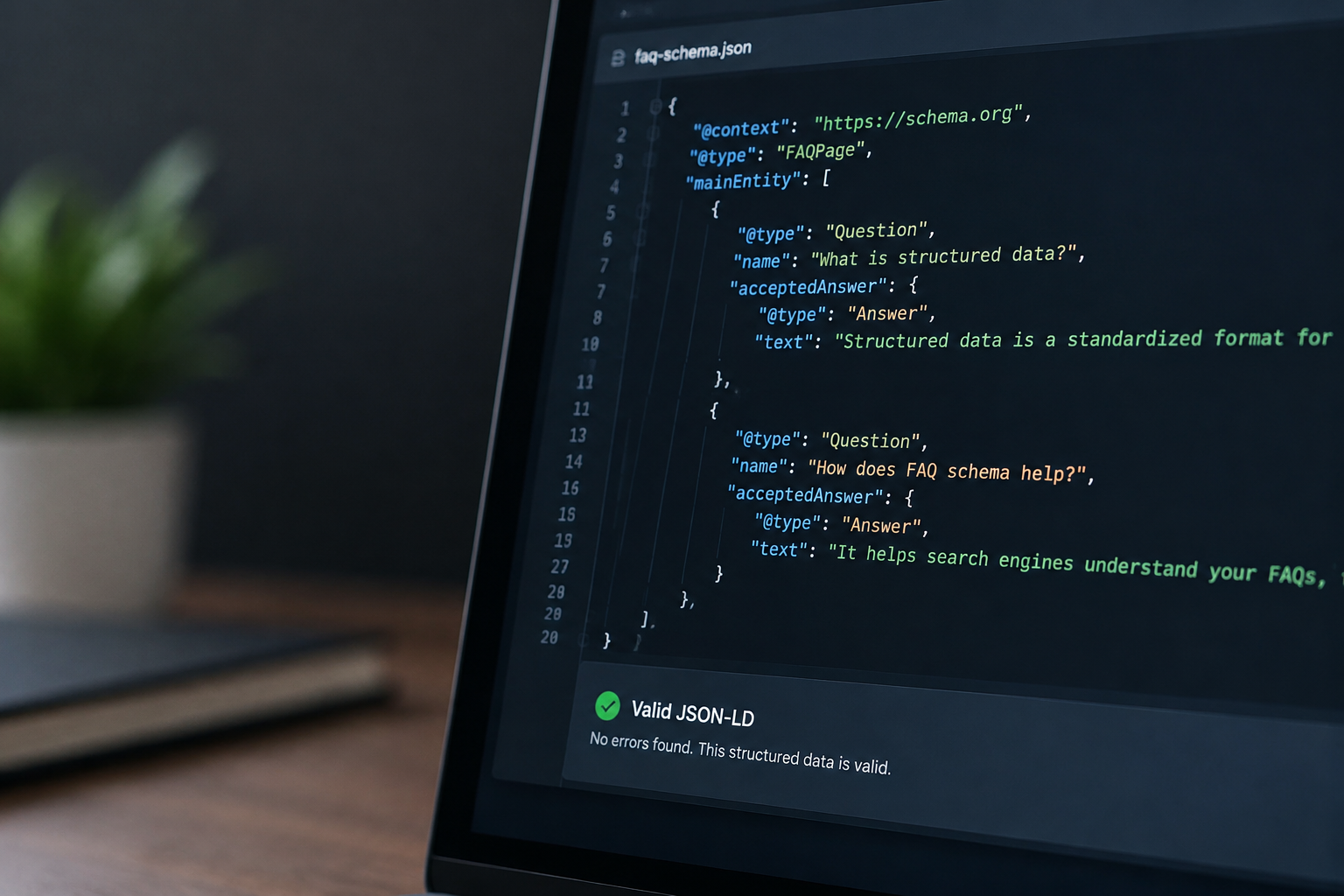
Quality AI tools generate valid JSON-LD schema markup for FAQ sections, article metadata, or product listings as part of the output package. This structured data helps search engines parse content more accurately and increases eligibility for rich results. The tool should produce machine-readable schema that passes validation in Google's Rich Results Test without manual corrections.
Check that every FAQ heading in the article has a corresponding Question entry in the schema, and that the acceptedAnswer text matches the article's actual answer. Mismatched or incomplete schema signals a lack of integration between content generation and technical SEO layers.
How Do You Evaluate Readability and Sentence Flow?
You evaluate readability by running the output through a tool that calculates Flesch Reading Ease or Flesch-Kincaid Grade Level, aiming for a grade level between eight and ten for general business audiences. Sentences longer than 25 words should be rare, and paragraphs should rarely exceed four sentences. The content should pass a silent read-through without awkward phrasing, unclear antecedents, or abrupt topic jumps.
Listen for rhythm by reading a section aloud. If you stumble over word order or lose the subject of a sentence midway, the AI has likely prioritized keyword insertion over natural syntax. Reliable platforms balance SEO requirements with human readability, producing text that editors can approve with minimal line-level edits.
What Role Do Transition Sentences Play in Flow?
Transition sentences guide the reader from one section to the next without generic filler phrases like "moving on" or "next, we will discuss." Strong transitions reference the previous point and preview the upcoming topic in a single sentence, maintaining logical progression. If every section starts cold without acknowledging the article's narrative arc, the content feels disjointed even when individual sections are well-written.
Are Images and Media Placeholders Strategically Positioned?
Image placeholders should appear three to five times throughout the article, positioned where a visual genuinely reinforces surrounding text rather than as decorative breaks. The tool should never place an image as the first or last element of the article, nor insert two back-to-back without intervening text. Each placeholder must include a descriptive caption and a detailed image prompt that specifies subject, composition, and visual style.
Review the image prompts for relevance and feasibility. Generic prompts like "business concept illustration" yield stock-photo cliches, while specific prompts tied to the section topic produce useful visuals. The FAQ section should remain image-free to maintain focus on question-and-answer clarity.
When Should You Edit AI Output Manually?
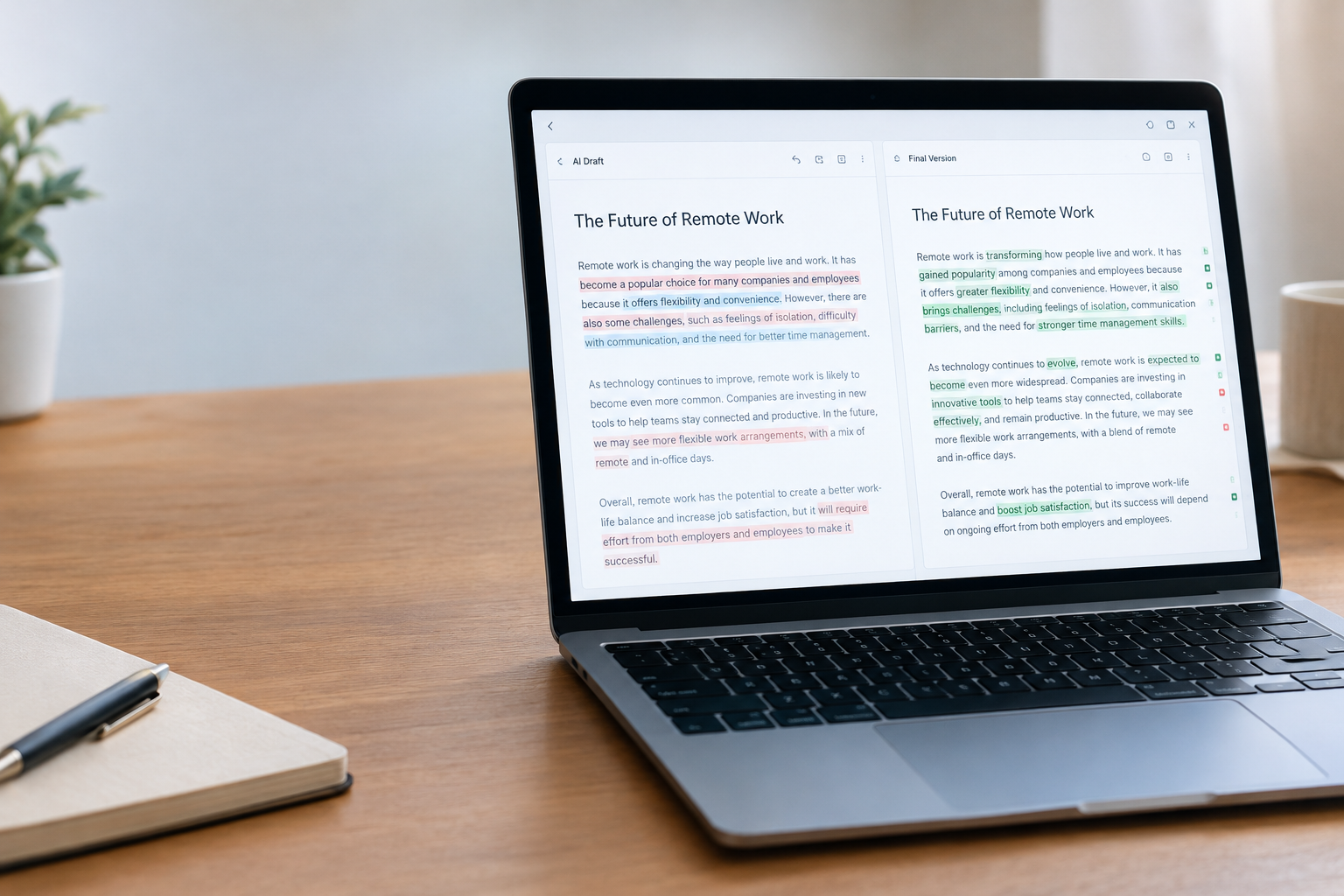
Manual editing becomes necessary when the AI tool produces factually dubious claims, awkward phrasing in high-visibility sections like the introduction or conclusion, or keyword placements that disrupt sentence flow. Even high-quality tools require human review to inject brand-specific examples, update time-sensitive information, or adjust tone for niche audiences. The goal is to minimize editing hours, not eliminate them entirely.
Focus manual effort on the opening paragraph, primary headings, and any section where the tool introduced a generic example instead of a specific, industry-relevant scenario. Small businesses and startups working with platforms like RankHit should prioritize editing for strategic differentiation, ensuring the content reflects unique positioning rather than reading like every competitor's article on the same topic.
Does the Tool Support Bulk Workflows and Publishing Automation?
A production-grade AI tool supports bulk content generation without sacrificing per-article quality, allowing users to queue multiple briefs and receive completed drafts in a single batch. The platform should integrate directly with content management systems like WordPress, enabling one-click publishing or scheduled releases. Manual copy-paste workflows introduce errors and slow velocity, particularly for teams managing ten or more articles per month.
Evaluate whether the tool preserves formatting, internal links, and image placeholders during export. If the platform strips HTML or flattens heading hierarchy when transferring to your CMS, you lose the efficiency gains that justified the investment. Automation should extend through the entire workflow, from keyword research to live publication.
Frequently Asked Questions
What is the minimum word count for SEO optimized articles generated by AI tools?
The minimum effective word count for SEO optimized articles is typically 1,200 words, though 1,500 to 1,800 words provides better coverage for competitive keywords. Shorter articles rarely achieve the depth required to rank for informational queries or satisfy user intent. The AI tool should allow custom word count ranges per brief rather than enforcing a single default length.
How often should AI-generated content be updated?
AI-generated content should be reviewed and updated every six to twelve months, or immediately when industry regulations, product offerings, or search algorithm priorities shift. Outdated statistics, deprecated best practices, or broken internal links damage both user experience and search rankings. Platforms that automate content creation should also offer refresh workflows to maintain accuracy over time.
Can AI tools handle technical SEO beyond content creation?
Advanced AI tools extend beyond content generation to automate internal linking, generate meta tags, create XML sitemaps, and produce structured schema markup. However, technical audits for site speed, mobile usability, and crawl errors still require specialized tools or manual review. The best platforms integrate content automation with broader SEO workflows rather than treating article generation as an isolated task.
What red flags indicate an AI tool produces low-quality SEO content?
Red flags include keyword density above 0.6 percent, fabricated statistics without sources, generic introductions that waste the first paragraph, missing heading hierarchy, and internal links that point to irrelevant pages. If the tool cannot provide samples demonstrating natural keyword integration and structured data output, assume quality issues exist. Free trials should reveal these problems within the first three articles.
Choosing an AI tool to create SEO optimized articles requires methodical evaluation against production standards, not surface-level feature lists. The checklist above isolates the variables that predict ranking success and editorial efficiency, so your content budget delivers measurable traffic growth rather than revision cycles. Test every candidate platform against these criteria, demand sample output that passes each checkpoint, and prioritize tools that integrate keyword research, content generation, and native publishing workflows into a single automated system. Quality at scale is the only metric that justifies the investment.

RankHit
RankHit official
RankHit researches keywords, writes SEO articles, and publishes them on autopilot so brands can rank on Google and get cited by ChatGPT.