AI Keyword Research and Content Writing: Unified Workflow
Optimize your workflow with AI keyword research and content writing combined into a unified process that saves time and improves search rankings.

Combining ai keyword research and content writing into a single workflow eliminates the friction of switching between tools, reduces manual handoffs, and ensures that every piece of content you publish is built on a foundation of search-optimized insights rather than guesswork.
Traditional SEO workflows split keyword research and content creation into separate phases, often using different platforms, spreadsheets, and manual coordination. That division creates bottlenecks: research sits unused while writers wait, keyword data gets misinterpreted, and content briefs lose precision in translation. A unified approach automates the handoff, feeding keyword insights directly into content generation so that search intent, topic clusters, and ranking opportunities shape every paragraph from the first draft.
This article walks through optimization strategies and best practices for merging AI keyword research and content writing into one seamless process, with actionable steps you can implement today to cut production time and improve search visibility.
Why unify keyword research with content creation?
Unifying keyword research with content creation ensures that every target keyword, search intent signal, and topical gap identified during research flows directly into the content brief and draft, removing the risk that valuable insights get lost or diluted between handoffs.
When research and writing happen in isolation, writers often reinterpret keyword data based on intuition rather than search behavior. A keyword flagged as high-priority for informational intent might be written as a product pitch, or a longtail opportunity might be buried in a generic paragraph instead of anchoring its own heading. Unified workflows prevent that drift by embedding keyword context, SERP features, related questions, and competitor gaps directly into the content generation prompt or template.
For small businesses and startups targeting competitive niches like SaaS SEO, this integration also compresses production cycles. Instead of waiting days for a research report, then days more for a first draft, a unified system can deliver a fully optimized article in hours, letting you publish faster and test positioning before competitors close the same keyword gaps.
How does AI handle keyword research and content writing together?
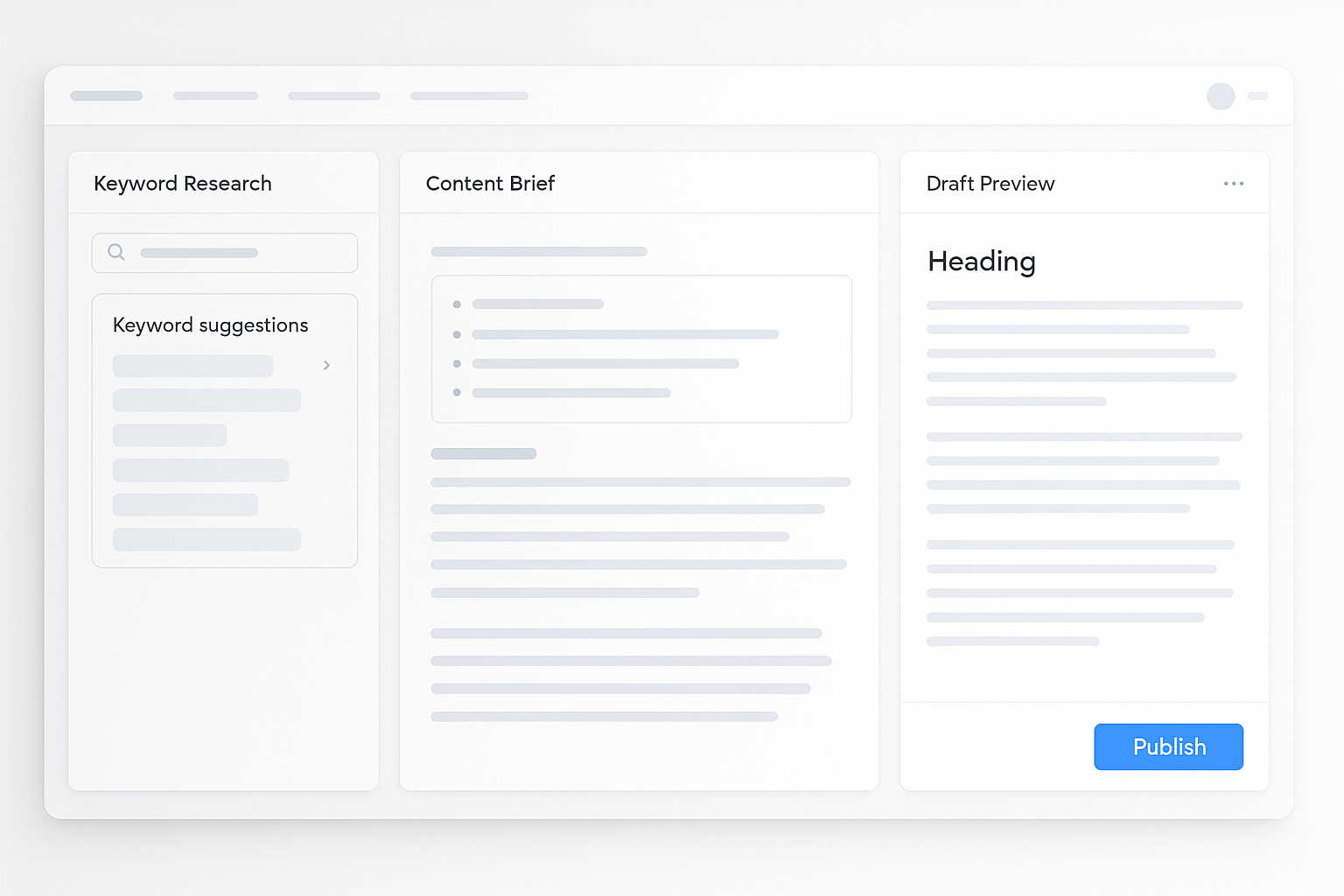
AI platforms built for unified workflows pull keyword data, analyze search intent, identify content gaps, and generate drafts in a single pipeline, using structured prompts that carry research insights through every stage of content creation without requiring manual summarization or translation.
The process starts with seed keywords or topic clusters. The AI queries search volume, competition, SERP features, and ranking difficulty, then identifies primary and longtail variations. Instead of exporting that data to a spreadsheet, the system feeds it directly into a content brief generator that structures headings, assigns keyword density targets, flags related questions, and maps internal linking opportunities. That brief becomes the scaffold for the draft, ensuring the AI writer knows which keywords to emphasize, which questions to answer, and which sections need depth before it writes the first sentence.
Advanced systems also cross-reference competitor content during the research phase, noting which subtopics rank well and which gaps exist. The content generator then prioritizes those gaps in the outline, letting you publish articles that cover angles competitors missed rather than rehashing the same generic advice. For businesses focused on topical authority, this competitive layer is what turns a single article into a ranking asset instead of noise.
What are the core components of a unified AI workflow?
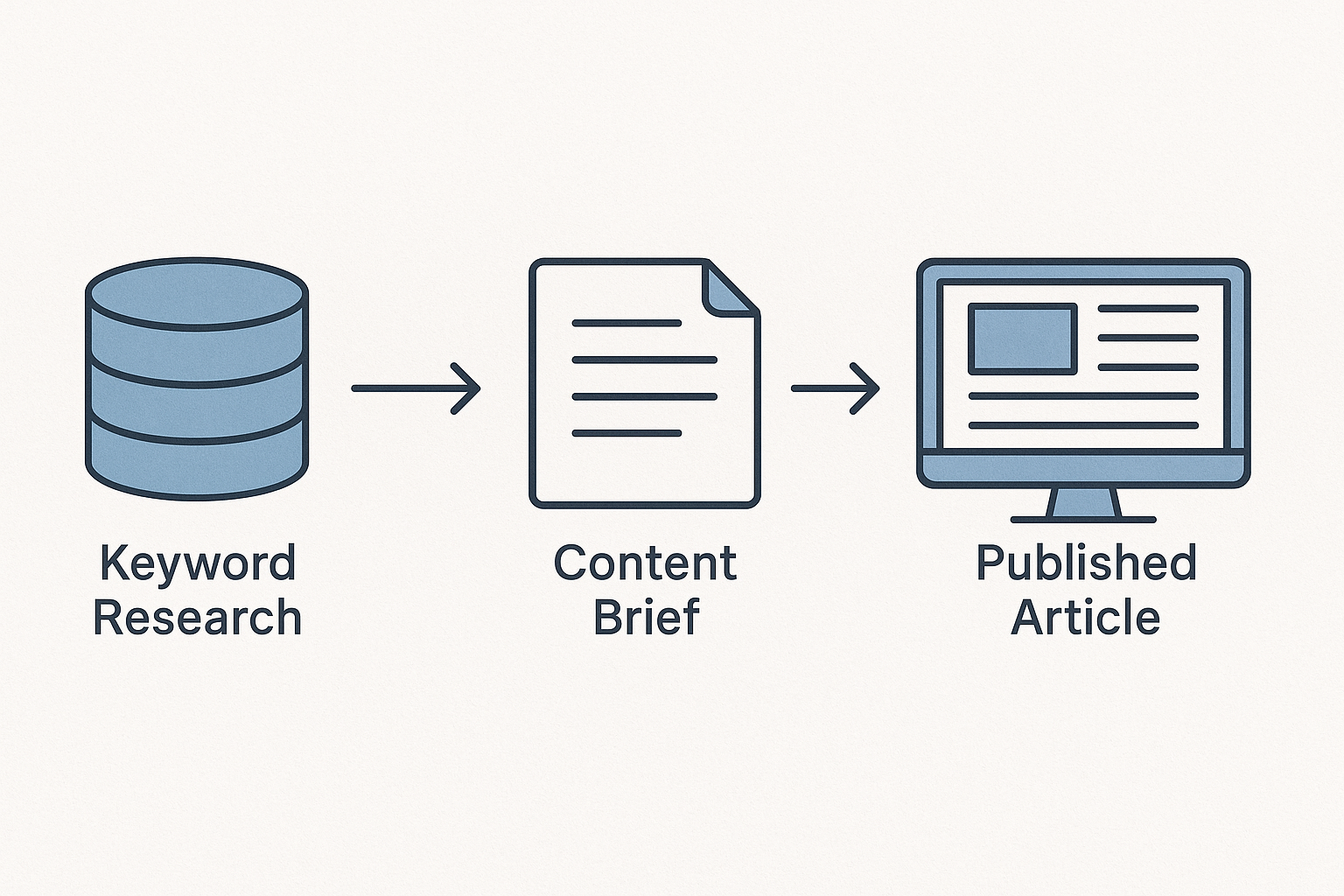
A complete unified workflow includes keyword discovery, search intent classification, content brief generation, draft creation, internal link insertion, and publishing automation, each feeding data forward so no step requires manual intervention to connect research insights with the final published article.
Keyword discovery pulls seed terms, expands them into clusters, and scores each by volume, difficulty, and relevance. Intent classification labels each keyword as informational, navigational, commercial, or transactional, shaping the article's structure and call to action. Brief generation translates that research into an outline with assigned headings, target word count, keyword density goals, and related questions. Draft creation writes the full article using that brief as a constraint, embedding keywords naturally and addressing each outlined section. Internal link insertion scans existing content and suggests relevant anchor placements. Publishing automation formats the draft, injects schema markup, and pushes it to the CMS without requiring manual copy-paste.
Each component must pass structured data to the next. If the brief generator cannot read keyword difficulty scores, it might prioritize the wrong headings. If the writer cannot see related questions, it will miss FAQ opportunities that could trigger featured snippets. The value of unification is in that lossless handoff, not just running separate AI tools faster.
How do you optimize keyword selection for automated content?
Optimizing keyword selection for automated content means filtering candidates by a combination of search volume, ranking difficulty, topical relevance, and existing content coverage, ensuring the AI focuses on keywords that match your domain authority and fill genuine gaps rather than chasing high-volume terms you cannot realistically rank for.
Start by setting floor and ceiling thresholds. For a new site or startup SEO campaign, target keywords with monthly search volume between 100 and 1,000 and difficulty scores below 30, where you can win rankings without extensive backlink campaigns. For established sites, raise the ceiling but maintain a portfolio mix, dedicating some content to easier longtail terms that convert even if they bring lower traffic. Filter out branded keywords unless you are creating comparison content, and exclude navigational queries that do not align with your funnel.
Topical relevance is harder to automate but critical. A keyword might have perfect volume and difficulty but sit outside your niche, diluting topical authority instead of building it. Use semantic clustering to group keywords by parent topic, then prioritize clusters that align with your core product or service. If your platform automates SEO content creation, a cluster around content automation, publishing workflows, and editorial calendars will strengthen your authority more than a cluster around generic marketing tips, even if the latter shows higher search volume.
Should you prioritize longtail or short-tail keywords in a unified workflow?
Prioritize longtail keywords in a unified workflow because they carry clearer search intent, face less competition, and convert better, making them ideal for automated content that needs to rank quickly and answer specific user questions rather than compete with high-authority publishers on broad terms.
Short-tail keywords like "SEO tools" attract massive search volume but also massive competition and ambiguous intent. A unified AI workflow can generate a well-optimized article targeting that term, but without significant domain authority and backlinks, the content will struggle to break into the top 50 results. Longtail variations like "AI tool for SEO content writing" or "how to automate SEO content creation" narrow the field, target users closer to a decision, and give you a realistic shot at page-one rankings within weeks instead of months.
In practice, build most of your content calendar around longtail opportunities, then create a smaller number of pillar articles targeting short-tail head terms. Link the longtail pieces to the pillars using contextual internal links, so the longtail articles that do rank pass authority upward and the pillar pages benefit from the topical cluster you have built around them.
How should search intent shape AI-generated content?
Search intent should dictate the article's structure, tone, depth, and call to action, ensuring that informational queries get how-to guides and comparisons, commercial queries get product breakdowns and feature lists, and transactional queries get clear next steps with minimal preamble.
When the AI identifies a keyword as informational, the content should open with a direct answer, expand into step-by-step guidance or conceptual explanation, include FAQ sections to capture related questions, and close with a soft call to action that offers a relevant tool or resource. For commercial intent, shift the balance toward comparison tables, feature highlights, use-case scenarios, and trust signals, with a stronger call to action pointing to pricing or a demo. Transactional intent requires the shortest path to conversion: cut the preamble, state the offer, show the benefits, and link directly to checkout or sign-up.
Mismatched intent is one of the most common failures in automated content. An AI that treats every keyword as informational will generate long educational articles for users ready to buy, frustrating them and tanking conversion rates. A system that treats every keyword as transactional will generate shallow sales copy for users still researching, losing their trust and failing to rank. Intent classification must happen during research and control the content template, not be retrofitted after the draft is written.
What role does topical clustering play in unified workflows?
Topical clustering organizes keywords into thematic groups anchored by a pillar topic, letting the AI generate a coordinated set of articles that link to one another, cover the topic comprehensively, and signal to search engines that your site has deep expertise rather than scattered one-off posts.
In a unified workflow, clustering happens during the research phase. The AI identifies a core topic, expands it into subtopics and related questions, then assigns each subtopic its own keyword and content brief. For example, a pillar topic like "AI SEO automation" might expand into clusters covering keyword research automation, content generation, internal linking, publishing workflows, and performance tracking. Each cluster article targets its own primary keyword, answers a specific set of questions, and links back to the pillar page and to related cluster articles.
This structure is especially powerful for platforms like RankHit that aim to build citations in AI-driven search engines like ChatGPT. Topical clusters demonstrate authority, increase the surface area of your content, and make it more likely that an AI assistant will cite your site as a comprehensive source rather than pulling a single fact and moving on. Tools like the AI topical map generator can automate cluster planning, feeding the results directly into your content pipeline.

How do you maintain content quality in an automated pipeline?
Maintaining content quality in an automated pipeline requires clear constraints in the content brief, validation checks that flag low-quality outputs before publishing, and periodic human review to ensure the AI stays aligned with brand voice, factual accuracy, and strategic goals.
Set minimum standards for each draft: target word count, heading count, keyword density range, internal link quota, and readability score. Configure the AI to reject drafts that fall outside those ranges and regenerate until the output meets every threshold. Add factual validation by cross-referencing claims against trusted sources or flagging sentences that include statistics, percentages, or named studies for manual verification. Use tone scoring to ensure the AI matches your brand voice, checking for formality, sentence variety, and appropriate use of technical vocabulary.
Even with strong constraints, human review remains essential. Schedule spot checks on a sample of published articles each week, looking for drift in quality, repetitive phrasing, outdated information, or misalignment with search intent. Use that feedback to refine the content brief templates and prompt engineering, so each iteration improves the baseline quality of automated output rather than requiring the same corrections every time.
Can AI-generated content rank as well as human-written content?
AI-generated content can rank as well as human-written content when it is optimized for search intent, includes accurate information, demonstrates topical depth, and is published within a broader strategy of internal linking and topical authority, because search engines prioritize relevance and user satisfaction over authorship method.
Google's guidelines focus on helpfulness, expertise, and trustworthiness, not whether a human or an algorithm wrote the text. An AI-generated article that answers a user's question thoroughly, cites credible sources, and fits naturally into a well-structured site will outrank a shallow human-written post that offers generic advice and weak internal linking. The key is ensuring the AI receives enough context and constraints to produce genuinely useful content, not template-driven filler.
Performance data supports this. Sites using AI SEO automation report ranking improvements when they pair content generation with strong keyword research, topical clustering, and ongoing optimization. The risk is not in using AI, but in using it poorly: publishing dozens of low-quality articles without strategic targeting, internal links, or quality checks will harm rankings regardless of whether a human or a machine wrote them.
What metrics should you track in a unified workflow?
Track keyword rankings for each published article, organic traffic growth by topic cluster, content production velocity, time from research to publish, click-through rates from search results, and conversion rates from organic traffic to leads or sales, using those metrics to identify bottlenecks and optimize both the workflow and the content strategy.
| Metric | What it measures | Why it matters |
|---|---|---|
| Keyword rankings | Position for target keywords | Shows whether content is reaching intended search queries |
| Organic traffic | Visitors from search engines | Validates that rankings translate into actual clicks and visits |
| Production velocity | Articles published per week | Measures workflow efficiency and capacity for scaling |
| Time to publish | Hours from research to live article | Identifies delays and opportunities to compress the pipeline |
| Click-through rate | Percentage of impressions that result in clicks | Indicates whether titles and meta descriptions are compelling |
| Conversion rate | Organic visitors who become leads or customers | Ties content performance to business outcomes |
Set up dashboards that update automatically, pulling data from your analytics platform, search console, and CRM. Compare performance across topic clusters to identify which themes drive the most traffic and conversions, then allocate more production capacity to high-performing clusters. Monitor time to publish closely; if the workflow consistently takes longer than expected, investigate whether bottlenecks sit in keyword approval, brief generation, draft review, or CMS integration, and adjust automation rules or staffing to address the constraint.
How do you integrate internal linking into automated content?
Integrate internal linking by scanning your existing content library during the drafting phase, identifying contextually relevant articles, and embedding anchor text inline within sentences where the topic naturally connects, rather than appending a generic list of related posts at the end.
Automated internal linking works best when the system maintains an indexed map of your published content, tagged by primary keyword, topic cluster, and intent. As the AI writes a new article, it queries that map for pages that match concepts mentioned in the draft. When the draft discusses keyword research, the system finds your existing article on keyword research automation and suggests an anchor placement. When it covers publishing, it links to your workflow or CMS integration page. Those suggestions are reviewed or approved before publish, ensuring links add value rather than clutter.
Avoid over-linking. A 1,500-word article should carry four to six internal links, distributed naturally across sections, not twenty links crammed into the introduction. Each link should use descriptive anchor text that tells the reader what they will find if they click, not vague phrases like "click here" or "learn more." Platforms like RankHit automate this step as part of the unified workflow, scanning for link opportunities and inserting them contextually so every published article strengthens your site's internal link graph without manual intervention.
What happens if you skip internal linking in a unified workflow?
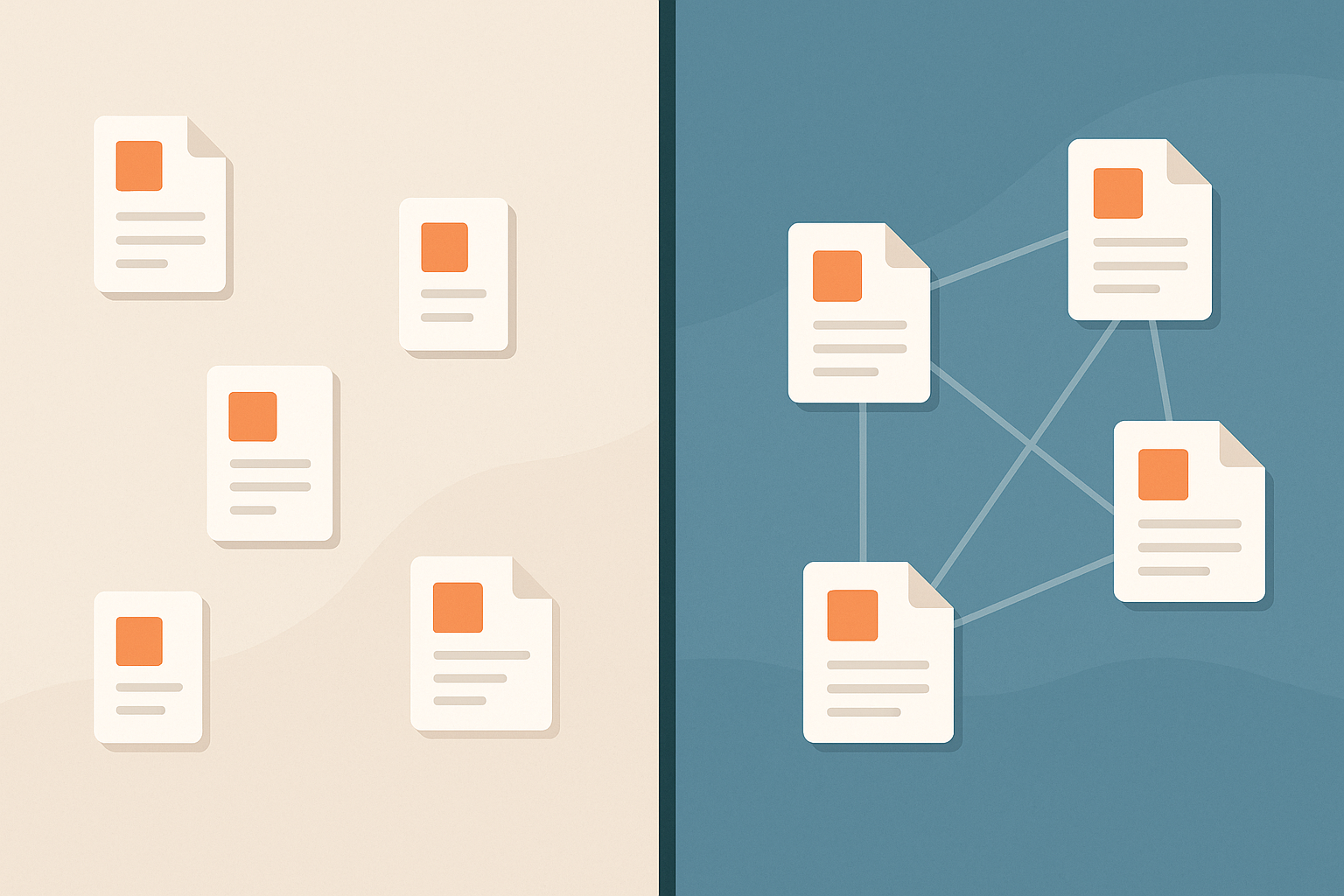
Skipping internal linking in a unified workflow isolates each article, preventing search engines from understanding topical relationships, diluting PageRank distribution, and reducing the likelihood that visitors discover related content, which weakens overall site authority and lowers the ranking potential of every individual page.
Internal links are the connective tissue that turns a collection of articles into a cohesive knowledge base. Without them, search engines treat each page as a standalone asset, missing the signal that multiple articles form a comprehensive cluster around a core topic. Visitors who land on one article have no clear path to explore deeper, leading to higher bounce rates and lower engagement. Over time, this fragmentation prevents the site from building topical authority, making it harder to rank even for longtail keywords where you should have a competitive advantage.
How do you scale content production without sacrificing quality?
Scale content production by treating the unified workflow as a repeatable system with clear quality gates at each stage, using batch processing for keyword research and brief generation, and allocating human review capacity proportionally as volume increases rather than attempting to manually edit every draft.
Start by batching keyword research: identify a month's worth of target keywords in a single session, score and prioritize them, then queue them for automated brief generation. This front-loading ensures the AI always has a backlog of vetted topics and reduces context-switching. Set quality thresholds in the content generator so drafts that fall below standards are automatically flagged for revision or human intervention, allowing high-quality drafts to flow straight to publish while problem cases get attention.
As volume grows, shift human review from line-by-line editing to spot-checking and template refinement. Instead of reading every article, review a random sample each week, measure performance against quality metrics, and adjust the content brief templates and AI prompts based on what you find. This approach lets you scale from ten articles per month to fifty or more without proportionally scaling your editorial team, because the system itself becomes more reliable with each iteration.
What are common mistakes in unified AI workflows?
Common mistakes include targeting keywords without validating search intent, skipping topical clustering in favor of isolated articles, over-optimizing for keyword density at the expense of readability, neglecting internal links, and publishing content without tracking performance metrics to inform future iterations.
Keyword selection errors are the most damaging. Choosing high-volume keywords far beyond your domain authority wastes production capacity on articles that will never rank. Publishing content for the wrong intent frustrates users and tanks engagement. Failing to cluster topics dilutes authority and makes it harder to rank for any keyword in the niche. Over-optimization produces robotic, repetitive text that readers abandon, signaling to search engines that the content is low quality even if it technically hits every SEO metric.
Another frequent mistake is treating automation as a set-and-forget solution. Unified workflows still require strategic oversight: reviewing performance data, refining templates, updating keyword targets as the market shifts, and ensuring the AI adapts to algorithm updates and changing user behavior. Businesses that treat AI as a replacement for strategy rather than an accelerant for execution see diminishing returns and eventually fall behind competitors who invest in continuous optimization.
How do you ensure content aligns with brand voice?
Ensure content aligns with brand voice by defining explicit tone guidelines in the content brief, providing example sentences or reference articles that demonstrate the desired voice, and scoring each draft against tone attributes like formality, sentence complexity, and vocabulary level before approving it for publish.
Write a tone profile that goes beyond labels like "professional" or "friendly." Specify sentence length targets, preferred point of view (first person, second person, third person), acceptable use of contractions, industry jargon, and rhetorical devices. Include positive and negative examples: sentences that capture the voice you want and sentences that miss it. Feed that profile into the AI's system prompt so every draft starts with the same foundation.
After drafting, run tone analysis using readability tools or custom scripts that flag deviations. If your brand voice is conversational but the AI produces stiff, formal prose, adjust the prompt to favor shorter sentences, active voice, and direct address. If the output is too casual, tighten vocabulary and reduce contractions. Iterate the tone profile based on feedback from spot checks, so the AI learns your voice over time rather than requiring manual rewriting on every article.
What tools support unified AI keyword research and content writing?
Tools that support unified AI keyword research and content writing integrate keyword discovery, search intent analysis, content brief generation, draft creation, internal linking, and publishing automation into a single platform, eliminating the need to export data between disconnected tools and ensuring research insights flow seamlessly into every published article.
RankHit automates the entire pipeline, from keyword research through content generation, internal link insertion, and publishing to your CMS, optimizing for both traditional search engines and AI-driven platforms like ChatGPT. The platform prioritizes research depth and topical clustering, ensuring each article builds authority rather than existing in isolation. It also offers native publishing capabilities, pushing completed articles directly to WordPress and other CMS platforms without manual formatting or copy-paste steps.
When evaluating tools, prioritize those that allow customization of tone, keyword targets, and quality thresholds. Generic content generators that treat every keyword the same way will produce shallow, repetitive articles that fail to rank. Look for platforms that let you define content briefs, approve outlines before drafting, and adjust internal linking rules to match your site structure. Check whether the tool integrates with your existing analytics and CMS, so performance data feeds back into keyword selection and content strategy without requiring manual data transfers.
Frequently Asked Questions
How long does it take to set up a unified AI workflow?
Setting up a unified AI workflow typically takes one to two weeks, including time to define keyword targets, configure content briefs, set tone guidelines, integrate with your CMS, and run test articles to validate quality and performance before scaling production.
The initial setup involves mapping your existing content, building a topic cluster plan, and configuring automation rules for keyword research, internal linking, and publishing. Plan for a trial period where you publish a small batch of articles, review their performance, and refine templates and prompts based on what you learn. This iteration is essential: rushing to full-scale production without testing will amplify any quality or strategy issues, requiring costly fixes later.
Can small businesses compete using AI keyword research and content writing?
Small businesses can compete using AI keyword research and content writing by targeting longtail keywords, focusing on niche topics where larger competitors underinvest, and leveraging automation to publish more frequently and build topical authority faster than they could with manual workflows alone.
The advantage lies in agility and focus. A small business using a unified workflow can identify a keyword gap, research it, generate a content brief, publish an optimized article, and start tracking performance within a single day. Larger competitors with complex approval chains and manual processes take weeks or months to execute the same cycle. By targeting keyword clusters that match their niche and using automation to maintain a consistent publishing cadence, small businesses build visibility and authority in specific topics where they can win, rather than spreading resources thin chasing broad, competitive terms.
How often should you update AI-generated content?
Update AI-generated content every six to twelve months, or sooner if keyword rankings drop, search intent shifts, or new information becomes available, ensuring the article remains accurate, relevant, and competitive against newer content published by competitors.
Set up monitoring alerts for ranking changes on high-priority articles. If a piece that ranked in the top five drops to page two, audit it for outdated information, missing subtopics that competitors now cover, or keyword drift where search intent has evolved. Refresh the content by adding new sections, updating statistics, improving internal links, and republishing with a current timestamp. Search engines reward freshness signals, and updated content often regains or improves its previous ranking.
What is the ROI of automating keyword research and content writing?
The ROI of automating keyword research and content writing depends on production volume, ranking velocity, and conversion rates, but businesses typically see positive returns within three to six months as organic traffic grows, reducing reliance on paid acquisition and generating leads or sales at a lower cost per acquisition than other channels.
Calculate ROI by comparing the cost of the automation platform and any staff time against the value of organic traffic. If automation lets you publish ten articles per month instead of two, and those articles collectively drive 1,000 additional monthly visitors at a conversion rate of two percent, that is 20 new leads per month. Multiply by average customer lifetime value to estimate revenue impact. For many businesses, especially those in local business SEO or ecommerce, the cost of automation is recovered within the first quarter, with compounding returns as published content continues to rank and attract traffic over time.
Does Google penalize AI-generated content?
Google does not penalize AI-generated content solely because it was created by AI; the search engine evaluates content based on helpfulness, expertise, and trustworthiness, meaning well-optimized, accurate, and valuable AI content can rank just as well as human-written content if it meets user needs and quality standards.
Google's official guidance focuses on whether content provides genuine value, not the method of production. The risk with AI-generated content is not the technology but the tendency to publish shallow, repetitive, or factually dubious articles at scale without quality controls. Sites that automate content production while maintaining strong editorial oversight, validating accuracy, and targeting real user intent see no penalty and often rank better than competitors still using slow manual workflows. The key is using AI as a tool to accelerate quality content creation, not as a shortcut to bypass quality altogether.
Unified workflows that combine ai keyword research and content writing deliver measurable advantages: faster production cycles, tighter alignment between search intent and content, stronger topical authority through clustering, and the ability to scale without proportionally scaling editorial teams. By treating research and writing as a single automated pipeline rather than disconnected manual tasks, you eliminate friction, reduce errors, and ensure every article published is optimized for both traditional search engines and AI-driven platforms like ChatGPT.
Start by auditing your current workflow to identify handoff delays, then select a platform that automates the full pipeline, from keyword discovery through publishing. Configure quality gates, define tone guidelines, and run a pilot batch of articles to validate performance before scaling. Track keyword rankings, organic traffic, and conversion rates to measure ROI, and use those insights to refine your keyword targets, content briefs, and automation rules over time. The businesses that invest in unified AI workflows today will build durable ranking advantages and capture market share while competitors continue to struggle with slow, manual processes.

RankHit
RankHit official
RankHit researches keywords, writes SEO articles, and publishes them on autopilot so brands can rank on Google and get cited by ChatGPT.