AI Tool to Create SEO Optimized Articles: Quality Checklist
Use this quality checklist when evaluating any AI tool to create SEO optimized articles. Ensure readability, structure, and ranking potential.

When you rely on any AI tool to create SEO optimized articles, output quality determines whether your content ranks or disappears into the void. This checklist walks you through the exact criteria to evaluate before hitting publish, ensuring every piece meets both human readability standards and the structural signals Google and AI search engines need to surface your work.
Why Quality Control Matters for AI-Generated SEO Content
Quality control separates content that drives organic traffic from content that wastes server space. AI models can produce fluent text at scale, but without systematic evaluation, they often generate articles that lack the depth, structural precision, and citation-worthy facts that determine ranking potential in 2026. A solid quality checklist catches missing internal links, keyword stuffing, shallow subsections, and the generic filler phrases that signal low value to both traditional search algorithms and large language model retrieval systems.
For businesses running SEO content automation at scale, manual review of every article is impractical. The checklist becomes your scalable quality gate, applied consistently across dozens or hundreds of posts each month, ensuring baseline standards even when human oversight is limited.
What Should You Check First in an AI-Generated Article?
Start with the title and introduction to confirm the piece delivers on its promised angle. The opening paragraph should include the primary keyword naturally and state the article's core value proposition within the first two sentences, not bury it under scene-setting filler. If the introduction opens with phrases like "in today's digital landscape" or "when it comes to SEO," flag it immediately for rewrite.
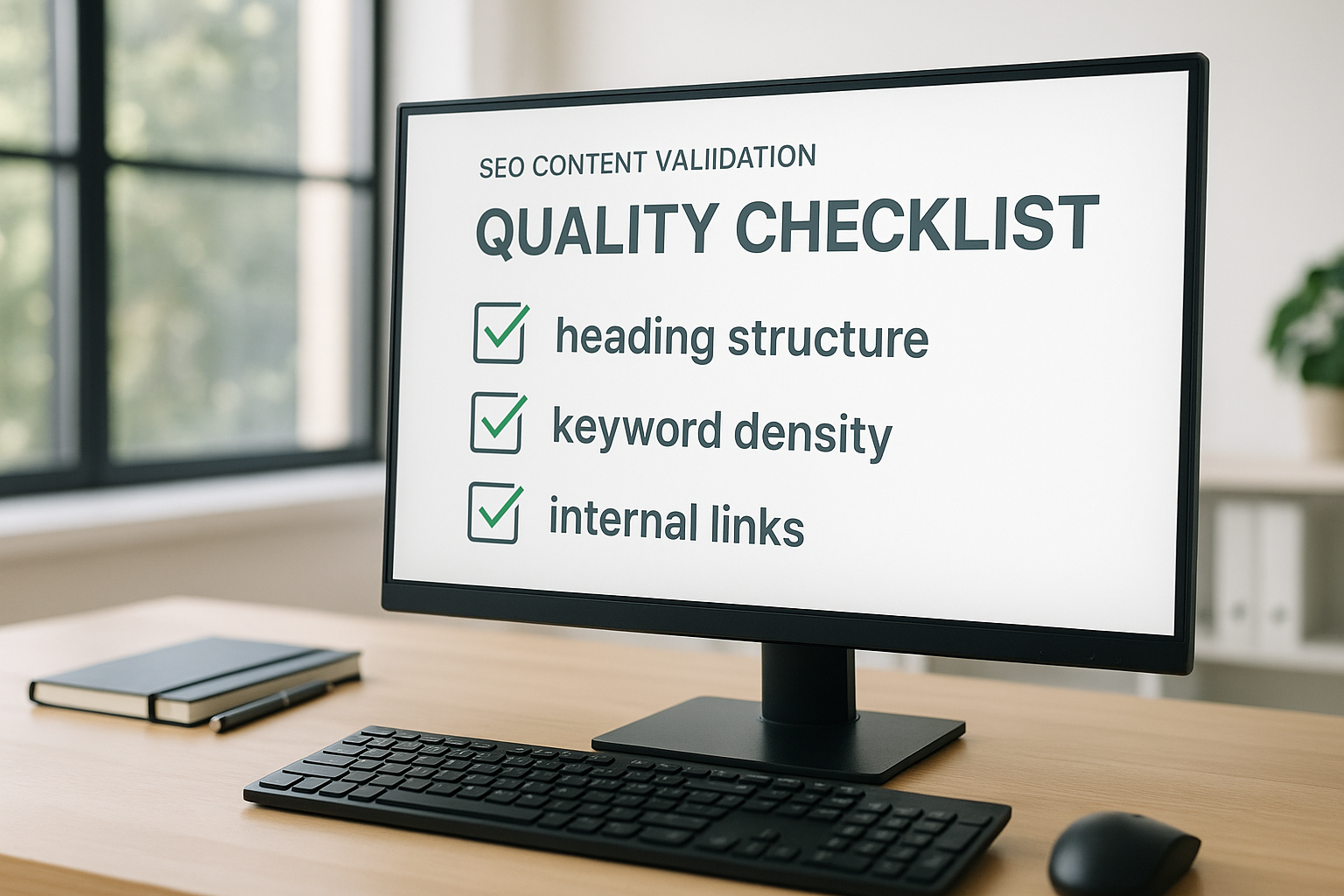
Next, scan the heading structure. Count total headings to verify the article includes enough signposts for scannable reading, typically 10 to 20 for a 1,500 to 1,800 word piece. Check that at least a third of those headings are phrased as direct questions, mirroring how real users query AI assistants and search engines. This structure improves the likelihood of citation in ChatGPT and other generative search results.
Does the Article Meet Target Word Count Without Padding?
Word count matters, but only when the content justifies the length. Articles shorter than 1,500 words often fail to cover a topic with enough depth to rank competitively, while those exceeding 1,800 words without adding new insights just dilute keyword density and bore readers. Read three random paragraphs: if each could be cut in half without losing meaning, the piece is padded.
Keyword Density and Placement Rules
Primary keyword density should land between 0.4 percent and 0.5 percent of total word count. For a 1,600-word article, that translates to six to eight natural mentions. Count exact-match instances, then verify the keyword appears at least once in a heading, once in the introduction, and once in the conclusion. Over-optimization triggers spam filters; under-optimization leaves ranking potential on the table.
Longtail keywords should appear two to four times each, woven into subheadings and body paragraphs where they fit organically. If inserting a keyword breaks sentence flow or forces awkward phrasing, use a close variant instead. Search engines parse synonyms and reordered phrases effectively in 2026, so rigid exact-match repetition is counterproductive.
| Keyword Type | Target Density | Minimum Placements | Red Flag |
|---|---|---|---|
| Primary Keyword | 0.4 to 0.5 percent | One in heading, intro, conclusion | Density above 0.6 percent or below 0.3 percent |
| Longtail Keywords | 2 to 4 mentions total | At least one in a subheading | Forced phrasing or broken grammar |
| Semantic Variants | Natural distribution | Throughout body paragraphs | Zero synonyms or related terms |
How Do You Verify Structural SEO Elements?
Structural elements are the scaffolding that helps search engines parse your content correctly. Check that the article contains zero H1 tags, since the platform title already serves that role, and that H2, H3, and occasional H4 tags create a clear hierarchy. Each heading should be followed immediately by a paragraph that opens with a self-contained sentence directly answering or addressing that heading, specific enough to stand alone if extracted as a snippet.
Internal links are equally critical. Every article should include four to six contextual links to other pages on your site, mixing blog posts and service pages where both are available. Links embedded mid-sentence with descriptive anchor text perform better than lists of "related articles" appended at the end. Verify that no invented URLs appear and that every link points to a page you actually control.
Are Tables and Visual Elements Used Effectively?
At least one well-formed HTML table should appear in every article longer than 1,200 words, summarizing comparisons, data breakdowns, or step-by-step processes. Tables improve scannability and increase the chance of featured snippet placement. Check that table headers are distinct, borders are visible, and cell padding makes text readable. A second table is valuable if the topic supports it, but avoid padding with redundant or low-information grids.
Image placeholders should be distributed logically through the article, positioned where visuals genuinely reinforce the surrounding text. Never place an image as the very first or last element, and never stack two images back to back without intervening paragraphs. Each placeholder needs a concise, descriptive caption and a corresponding detailed prompt for the image generation model.
Readability and Tone Consistency
Readability determines whether visitors stay on the page or bounce within seconds. Run the article through a readability analyzer targeting a Flesch Reading Ease score above 60, which corresponds to an eighth- to ninth-grade reading level. Sentences should average 15 to 20 words, paragraphs should rarely exceed four lines on a desktop screen, and passive voice should account for less than 10 percent of sentences.
Tone consistency is harder to automate but just as important. Every paragraph, table caption, and FAQ answer should reflect the same professional voice. If the introduction is formal and data-driven but the conclusion suddenly shifts to chatty or sales-heavy language, the inconsistency signals AI generation to trained readers and degrades trust. For platforms like RankHit that optimize for AI search citations, maintaining a credible, authoritative tone throughout increases the likelihood of being quoted by ChatGPT and similar models.
What Red Flags Indicate Low-Quality AI Output?
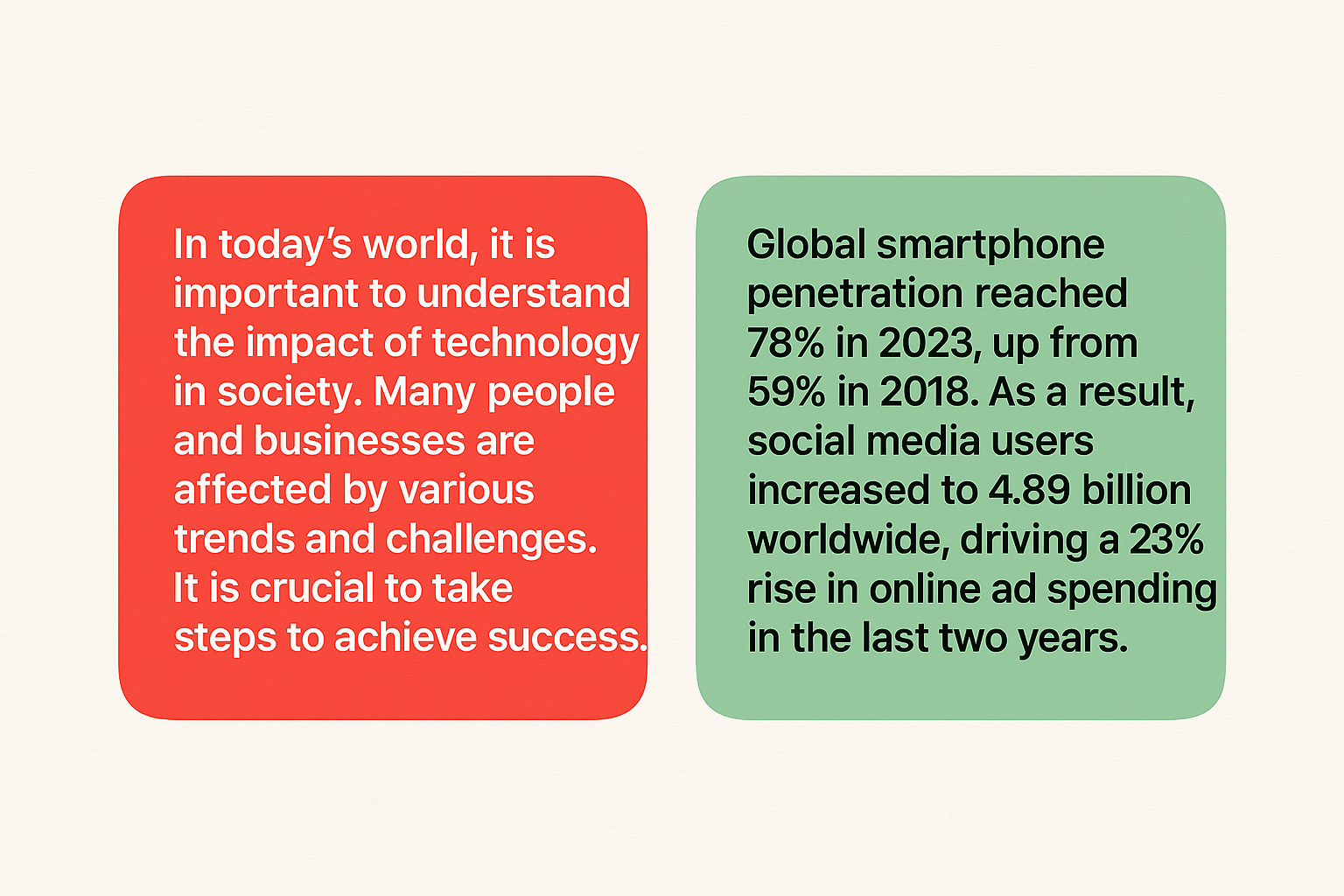
Generic opening phrases like "in today's fast-paced world," "when it comes to," or "the ever-evolving landscape of" are instant red flags. So are paragraphs that restate the heading in sentence form without adding a specific claim, example, or actionable step. If you can swap out the business name and niche without changing the rest of the content, the article lacks the specificity needed to rank.
Fabricated statistics, vague references to "studies show," and invented plan names or pricing details are disqualifying errors. AI models sometimes hallucinate data points to fill gaps; every number, study name, or feature claim must be verified against real sources or removed. Similarly, competitor brand names should never appear in the body text, even in comparison tables.
Checking for Factual Accuracy and Source Integrity
Factual accuracy is non-negotiable. Cross-reference every claim that includes a number, a named source, or a specific recommendation against authoritative data. If the AI cites a percentage or a study without a verifiable origin, either replace it with a general defensible statement or remove the claim entirely. Misinformation damages both SEO performance and brand reputation.
Check that the article avoids referencing outdated years. If the content mentions trends, tools, or best practices "in 2024" when the current year is 2026, it signals stale generation. Year references should match the actual publication date or use evergreen phrasing like "currently" or "today" instead of hardcoded calendar years.
How to Evaluate Internal Linking Strategy?
Internal links distribute page authority and guide readers to related resources, but only when placed strategically. Count the total number of internal links and verify it falls between four and six per article. Links should anchor on descriptive phrases that preview the destination page's topic, not generic "click here" or "learn more" text.
Mix blog post links with service or tool page links where both are available. For instance, an article on AI SEO automation might link to a content brief generator tool and a related blog post on how AI SEO automation works. This diversity signals a well-connected site architecture and improves crawl efficiency.
Should Every Article Include a FAQ Section?
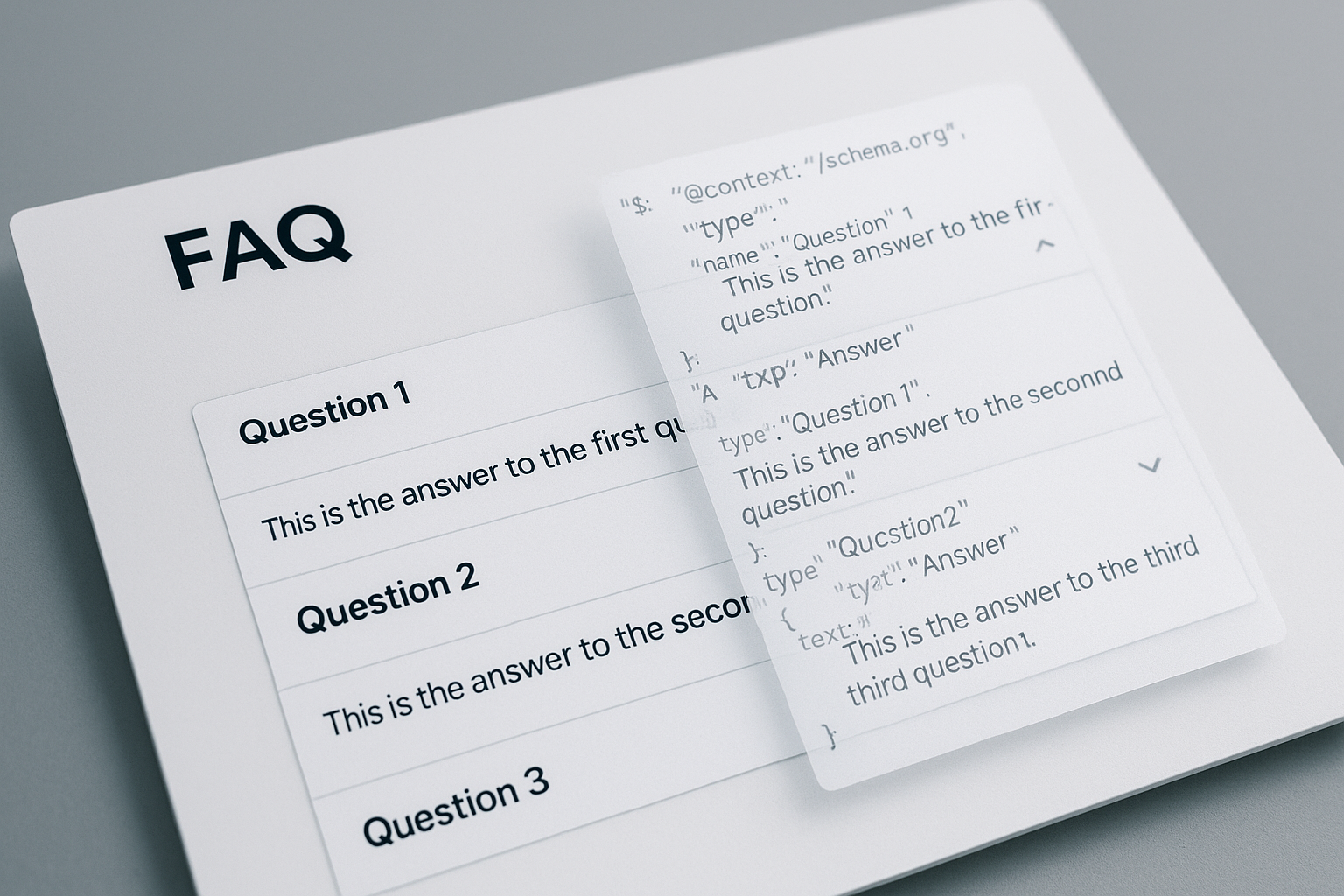
A short FAQ section near the end of the article, containing three to five questions, is one of the most efficient ways to reach the target heading count while addressing common search queries. Each question should be phrased exactly as a real user would type it into a search box or voice assistant, and the answer should open with a direct, self-contained sentence before elaborating further.
FAQ sections also provide structured data opportunities. Generating a valid FAQPage schema object for each article increases the chance of rich snippet display in search results and improves compatibility with AI retrieval systems that extract question-answer pairs for citations.
Frequently Asked Questions
How do I know if an AI tool to create SEO optimized articles is producing quality content?
Quality AI-generated content meets specific benchmarks: keyword density between 0.4 and 0.5 percent, 10 to 20 headings with at least 30 percent phrased as questions, four to six contextual internal links, and zero fabricated statistics or generic filler phrases. Run each article through this checklist, counting manually rather than estimating, to confirm it meets structural and readability standards before publishing.
What is the ideal keyword density for SEO articles in 2026?
The ideal primary keyword density remains 0.4 to 0.5 percent of total word count, which translates to roughly six to nine mentions in a 1,500 to 1,800 word article. Densities above 0.6 percent risk triggering over-optimization penalties, while densities below 0.3 percent fail to signal topical relevance clearly enough to rank competitively.
Why does heading structure matter for AI search citations?
AI search engines like ChatGPT extract snippets by parsing heading hierarchies and the sentences immediately following each heading. Articles with clear H2 and H3 tags, question-based headings, and direct-answer opening sentences in each section are significantly more likely to be cited because the retrieval models can identify discrete, quotable claims without ambiguity.
Can I automate quality checks for AI-generated SEO content?
Yes, most structural checks can be automated using scripts or built-in platform features. Tools like RankHit's automated content workflow apply keyword density validation, heading count verification, internal link insertion, and schema generation programmatically, allowing you to scale content production while maintaining consistent quality standards.
What should I do if an AI article fails the quality checklist?
If an article fails multiple checklist items, regenerate it with stricter parameters rather than attempting extensive manual edits. Specify target keyword density, minimum heading count, required internal link anchors, and tone guidelines in your prompt or configuration. For persistent issues, review the AI model's training data and adjust the content brief to provide more specific examples and constraints.
Implementing the Checklist in Your Workflow
Turn this checklist into a repeatable process by creating a scoring sheet that assigns point values to each criterion: one point for correct keyword density, one point for heading count within range, one point for table inclusion, and so on. Set a minimum passing score, such as 10 out of 12, and reject any article that falls below that threshold before publication.
Integrate the checklist into your content calendar workflow. If you publish multiple articles per week, run the check immediately after generation, when revision is fastest. For businesses using end-to-end automation platforms, configure the system to flag or hold articles that fail specific rules, creating a manual review queue for borderline cases while auto-publishing those that pass cleanly.
When you consistently apply this quality framework to every AI tool to create SEO optimized articles, your content library becomes a reliable traffic asset rather than a gamble. Structural precision, keyword discipline, and readability standards compound over time, building topical authority and citation credibility that translate directly into higher rankings and more qualified leads from organic search.

RankHit
RankHit official
RankHit researches keywords, writes SEO articles, and publishes them on autopilot so brands can rank on Google and get cited by ChatGPT.